

Former President Uhuru Kenyatta has resigned from his position as chairman of the Azimio coalition, just days after the leadership of his Jubilee Party was handed over, marking a major shift in the opposition camp ahead of the 2027 General Election.
Kenyatta’s resignation, contained in a letter dated October 5, 2026, comes as the coalition completes its transition from the Azimio la Umoja identity to the newly adopted Ukombozi Alliance (TUA).
The move is likely to fuel fresh debate over the future direction of the opposition coalition and the balance of power among its senior leaders less than a year before the 2027 elections.
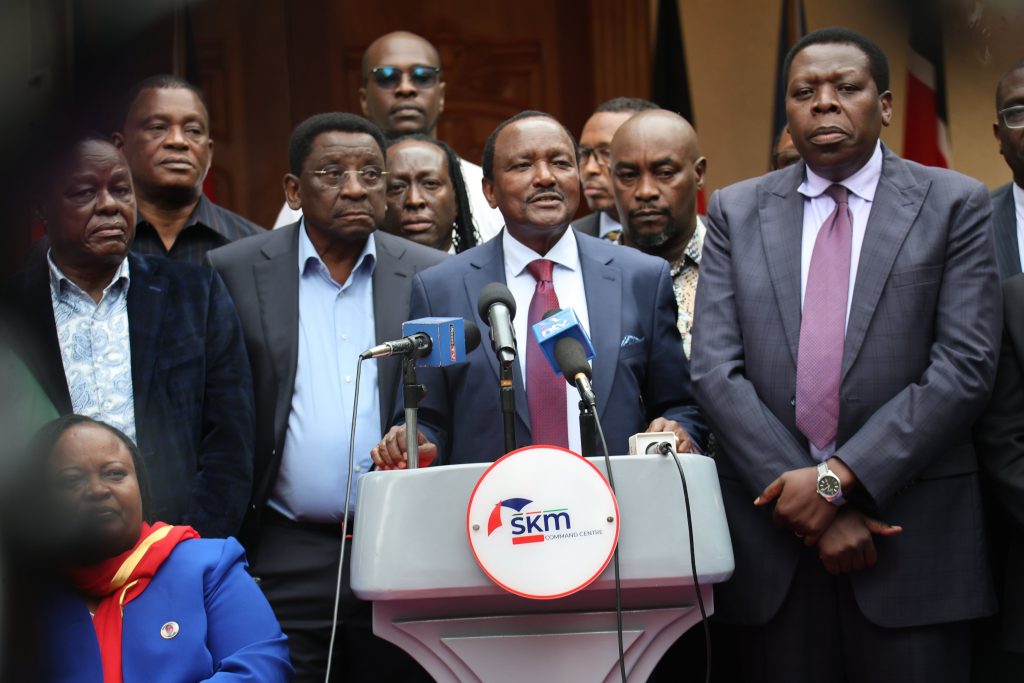
In a statement issued Wednesday, TUA Party Leader Stephen Kalonzo Musyoka confirmed that he had received Kenyatta’s resignation and moved to reassure members that the former president’s decision would not break the coalition apart.
“A coalition is not a temporary alliance of convenience but a covenant of conviction,” Kalonzo said.
He thanked Kenyatta for his contribution to the coalition, particularly his role in defending what he described as its democratic ideals.
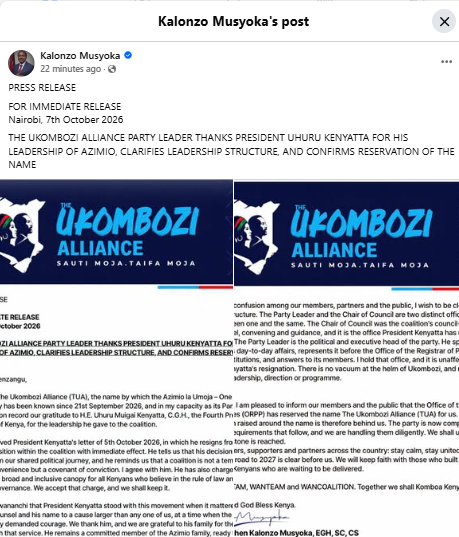
“President Kenyatta stood with this movement when it mattered. He lent his stature, his counsel and his name to a cause larger than any one of us, at a time when the defence of our democracy demanded courage,” Kalonzo said.
The former president, he added, remains part of the wider political family and will be invited to an official handover ceremony.
Kenyatta exit comes after Jubilee transition
Kenyatta’s resignation comes only days after developments surrounding the leadership of Jubilee Party, adding another layer of significance to his withdrawal from the formal leadership of the opposition coalition.
The former president has remained an influential figure in opposition politics since leaving State House in 2022, despite increasingly taking a less direct role in day-to-day party affairs.
His latest decision removes him from the formal leadership structure of a coalition that is now seeking to rebuild and reorganise itself ahead of the next presidential and parliamentary elections.
It also comes at a time when opposition parties are reassessing their alliances and leadership structures in preparation for what is expected to be a fiercely contested 2027 election.
Kalonzo clarifies who is in charge
Kalonzo used the announcement to clarify the structure of the Ukombozi Alliance and draw a distinction between the office previously occupied by Kenyatta and the position of party leader.
He said the chairperson of the council and the party leader are separate offices with distinct responsibilities.
According to Kalonzo, Kenyatta’s role was principally centred on counsel, convening and strategic guidance, while the party leader is responsible for the political and executive management of the organisation.
“The Party Leader is the political and executive head of the party. He speaks for the party, runs its day-to-day affairs, represents it before the Office of the Registrar of Political Parties and other institutions, and answers to its members,” Kalonzo said.
He stressed that his position had not been affected by Kenyatta’s resignation.
“I hold that office, and it is unaffected by President Kenyatta’s resignation,” he said.
Kalonzo also rejected suggestions that the former president’s departure had left the coalition without a clear leader.
“There is no vacuum at the helm of Ukombozi, and no change in the party’s leadership, direction or programme,” he said.
The statement appears designed to calm speculation over a possible leadership crisis within the rebranded opposition coalition.
Ukombozi identity takes shape
Kalonzo also announced that the Office of the Registrar of Political Parties has reserved the name The Ukombozi Alliance (TUA), giving the coalition a clearer path towards completing its transition from the Azimio la Umoja identity.
The coalition adopted Ukombozi as its new political identity on September 21, 2026.
Kalonzo said the party was now finalising the remaining compliance requirements and would keep its supporters informed as the process progresses.
The development gives the opposition coalition a new political brand as it prepares for the 2027 elections, although independent confirmation from the ORPP had not been obtained by the time of publication.

What Kenyatta’s exit means for 2027
Kenyatta’s resignation could nevertheless have political consequences beyond the formal organisational structure of the coalition.
As a former president and one of Kenya’s most recognisable political figures, his presence has given the opposition bloc considerable political weight. His withdrawal from its formal leadership comes at a sensitive moment as rival political formations begin positioning themselves for 2027.
For Kalonzo, however, the immediate message is that the coalition remains intact.
“The road to 2027 is clear before us. We will keep faith with those who built this coalition, and with the Kenyans who are waiting to be delivered,” he said.
The immediate next step will be the planned handover ceremony, which could offer further clues about Kenyatta’s future involvement in the coalition.
While his resignation removes him from formal leadership, it does not necessarily end his influence in opposition politics.
For Ukombozi, the bigger test will be whether Kalonzo can maintain unity, complete the coalition’s organisational transition and bring its constituent parties together behind a coherent strategy for the 2027 General Election.
Kenyatta’s departure has therefore closed one chapter of his formal role in the opposition movement. The political question now is what role, if any, he will play in the next chapter.