
Nearly 30 suspected fraudsters have been arrested in Ghana and Nigeria, while 3.7 million online profiles and accounts have been taken down in an international operation targeting cybercrime networks operating across Africa.
The crackdown, coordinated through an initiative hosted by the United Kingdom’s National Crime Agency (NCA), targeted criminal groups accused of using social media and other online platforms to defraud victims in the UK and other countries.
The operation brought together more than 100 representatives from law enforcement agencies and technology companies in London between October 6 and 9, 2026, with enforcement activities also conducted before and during the meeting.
“Almost 30 suspected scammers have been arrested and 3.7 million online profiles and accounts removed as part of a NCA-hosted crackdown against fraud perpetrated from across Africa.”
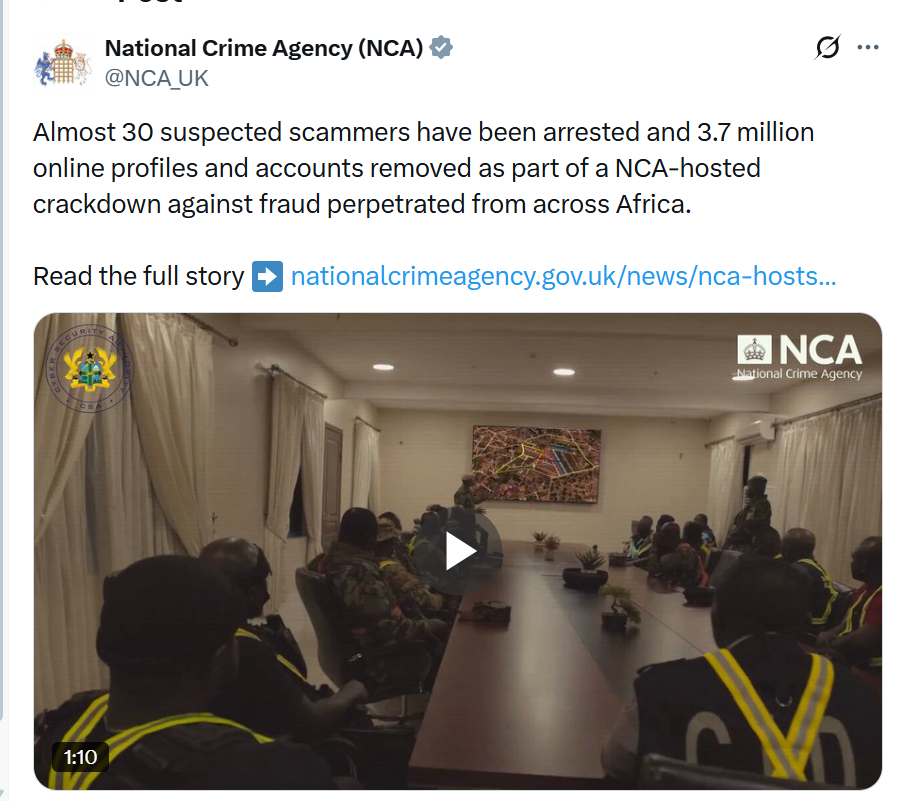
The initiative focused on fraud schemes involving fake investment opportunities and impersonation, in which criminals allegedly use online profiles to deceive unsuspecting victims.
Arrests and electronic devices seized
In Ghana, 19 people were arrested in Sasaabi, in the Accra region, during the operation. Officers also seized 303 electronic devices, while 117 people identified as suspected trafficking victims were awaiting repatriation to Nigeria.
In Nigeria’s Delta State, authorities arrested nine people and recovered six laptops, 35 mobile phones and 12 internet routers.
The latest arrests followed separate enforcement operations conducted by Ghanaian authorities towards the end of September, which also targeted suspected scam centres in the same area.
During those earlier raids, officers arrested several suspects and seized 85 mobile phones and 44 laptops.
Authorities also identified individuals believed to have been trafficked and potentially coerced into participating in criminal activities. Some were reportedly identified as victims only after they had been taken into custody.
Millions of social media accounts disabled
Technology companies also played a significant role in disrupting the digital infrastructure allegedly used by the fraud networks.
Meta disabled more than 1,110 Facebook and Instagram accounts in West Africa linked to information supplied by the UK’s Report Fraud service.

A separate enforcement effort, identified as OCC Data Enforcement, resulted in the removal of more than 490 Facebook accounts and over 490 advertising accounts.
Additionally, OCC Data Domain Enforcement identified and disabled more than 380 websites believed to be potentially connected to scam operations.
The wider crackdown resulted in Meta removing approximately 3.7 million online profiles and accounts.
Private-sector partners also identified potential funds worth approximately KSh1.42 billion that could be frozen as part of efforts to disrupt the financial operations of suspected criminal networks.
The amount is an approximate conversion of the reported US$11 million, using an illustrative exchange rate of KSh129 per US dollar. The actual value may vary with prevailing exchange rates.
International agencies join forces
The operation involved law enforcement representatives from 15 agencies, including the FBI, Nigeria Police Force and Ghana’s Cyber Security Authority.
Representatives from 15 private-sector companies, including Meta, Microsoft and Google, also participated.
The initiative was the fourth of its kind but the first hosted by the NCA. It brought together West African enforcement agencies and members of the Five Eyes Law Enforcement Group (FELEG).

Meta helped coordinate the initiative and mobilise participation from technology companies, while Report Fraud provided information intended to help identify individuals and networks facilitating online scams.
The NCA and its international partners worked with technology firms to trace suspects and support arrests.
The operation was funded through the UK Home Office’s Integrated Security Fund, which supports security-related initiatives.
Authorities said the joint effort was aimed at disrupting the people, digital platforms and infrastructure used to carry out cross-border fraud.