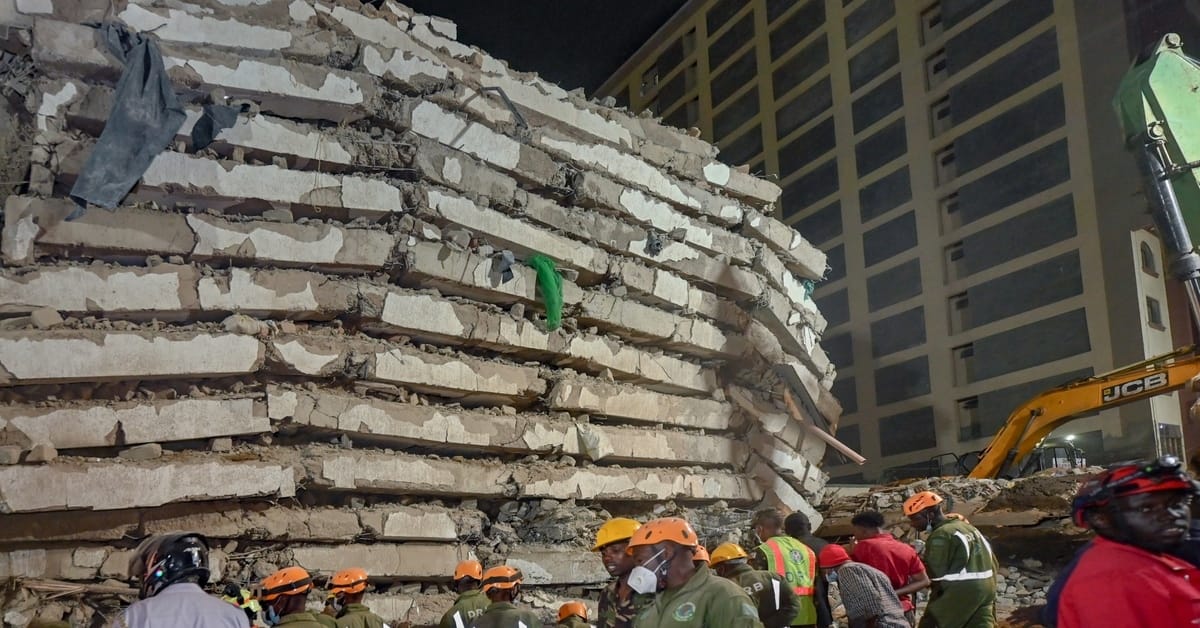
The collapse of a multi-storey building along 9th Street in Eastleigh has intensified scrutiny of Nairobi County’s building approval and enforcement systems, raising questions about how construction can proceed amid disputed permits and alleged regulatory failures.
The disaster on Friday, October 23, has also renewed concerns about allegations of bribery within Nairobi City Hall’s Urban Planning Department, where professionals have questioned the integrity of the approval process and the effectiveness of controls intended to prevent unauthorised construction.
At the centre of the controversy is a fundamental distinction: obtaining permission to change a property’s use does not necessarily authorise the construction of a new building.
Nairobi Governor Johnson Sakaja has said the county approved a change of use for the Eastleigh property in October 2024 but did not approve the architectural plans required for the building.
“There was a change-of-use application that was granted, but the building application was not granted,” Sakaja said on October 24.
His explanation raises questions about how construction reportedly progressed despite the stated absence of approved building plans and earlier enforcement action.

The collapse has therefore placed renewed attention on the entire regulatory chain, from planning applications and construction registration to inspections, environmental compliance and enforcement against developers who violate requirements.
Eastleigh collapse raises questions over construction approvals
The county’s account is that approval to change the property from residential to commercial-residential use was granted on October 17, 2024, while subsequent architectural plans submitted on November 20, 2024, were not approved.
The distinction is central to establishing whether the development was authorised.
A change-of-use approval concerns the permitted use of a property. It is not, by itself, permission to construct a building of any size or design. Construction must satisfy the applicable planning, building and other regulatory requirements.
The National Environment Management Authority (NEMA) also reportedly did not issue an environmental impact assessment licence for the project after requesting clearer architectural drawings in a letter dated January 6, 2026. The developer was advised to resubmit the documents but reportedly did not do so.
The National Construction Authority, meanwhile, said the project was registered on July 30, 2025. However, the project’s details were not returned by a search of its online portal late on Friday, October 23, and appeared the following day.
The timing raises legitimate questions about the accessibility and management of the records. It does not, on its own, establish when the online entry was created or whether any official deliberately altered the system.
Investigators will need to establish how the different approvals were handled, whether the relevant agencies communicated effectively and why construction continued despite the county’s stated position on the building plans.
By Monday, October 26, rescue operations were continuing, with authorities reporting four survivors rescued from the rubble. Reported missing-person figures had varied as agencies verified information from families, making it important to distinguish preliminary missing-person reports from confirmed casualty figures.
The cause of the collapse must also be established through technical investigations rather than inferred from irregularities in the approval process alone.
Alleged Ksh15 million payments put City Hall under pressure
Separate allegations concerning Nairobi’s building approval process have brought the Urban Planning Department under renewed scrutiny.
Professionals appearing before the Nairobi County Assembly’s Urban Planning Committee have described alleged interference with the county’s digital approval system, claiming that technical disruptions can force applicants to seek assistance through physical meetings at City Hall.
The allegations also include claims that some investors in high-value neighbourhoods, including Kilimani, Kileleshwa and Runda, have been asked to pay as much as Ksh15 million to secure approvals.
The figure remains an allegation, not an established fee or a proven payment to a public official. There is also no established evidence presented here linking such a payment to the collapsed Eastleigh building.
Nevertheless, the claims raise concerns about whether access to approvals is determined by compliance with planning requirements or by unofficial arrangements.
If payments are being demanded to bypass regulatory requirements, the consequences could extend beyond corruption. Developers who comply with the law could face unfair competition, while residents and property buyers could be exposed to buildings that have not undergone the necessary scrutiny.
Establishing whether the allegations are true requires evidence identifying who allegedly requested payments, what decisions were involved, whether money changed hands and whether approvals or enforcement decisions were improperly influenced.

Planning officials question interference with digital approvals
Digitising public services is intended to make decisions more transparent, reduce unnecessary discretion and leave an auditable record of how applications are processed.
However, a digital platform cannot guarantee accountability if its controls are weak, records are incomplete or officials can bypass established procedures.
Architectural Association of Kenya Vice-President Brenda Nyawara raised concerns about the county’s approval system during a consultative meeting with planning professionals on September 29.
“We are also asking why the portal keeps going down. Could it be deliberate? Could there be officers intentionally slowing approvals so that developers are forced to come to City Hall or make phone calls to secure approvals?” she asked.
Her remarks raise questions about recurring technical interruptions and whether they create opportunities for irregular dealings.
But the possibility of deliberate interference should not be treated as proof that the portal was manipulated. Establishing that would require technical logs, application histories, outage records and evidence of any unauthorised changes.
The county should be able to demonstrate when applications were submitted, which officers handled them, why decisions were made and whether any amendments were authorised.
Such records would help distinguish legitimate technical problems from administrative negligence or deliberate interference.
Disputed approval authority raises accountability concerns
Questions about responsibility for building approvals have also arisen in previous proceedings before the Nairobi County Assembly.
In November 2023, Frederick Ochanda, then acting assistant director of development, told the Assembly’s planning committee that he had approved close to 600 buildings, saying his authority had been delegated by Governor Johnson Sakaja.
The disclosure prompted questions about the division of responsibilities among county officials.
Then Chief Officer Patrick Analo disputed his ability to account for the approvals being issued through the system.
“I cannot account for the building approvals that have been released by the county government. I don’t have rights to this system. I don’t know when the changes were made,” Analo said.
The exchange exposed a serious accountability question: how can the county maintain reliable oversight when officials disagree over who holds approval authority and who can access the relevant records?
The reported number of approvals does not, by itself, establish that the buildings were illegally authorised or structurally unsafe. Nor does a disagreement between officials prove corruption.
The episode nevertheless demonstrates why approval powers, access rights and responsibility for decisions must be clearly defined and documented.
Where responsibilities are unclear, it becomes harder to establish who authorised a development, who should have detected a violation and which official should answer for a failure to act.
Building inspections remain critical to public safety
An approved building plan is only one part of construction safety. Developers must also build in accordance with the approved design and meet applicable technical requirements throughout the project.
Inspections at excavation, foundation, reinforcement and subsequent construction stages help authorities identify deviations before they create serious risks.
Town planners have previously criticised weak follow-up by both national and county governments after approvals are granted, arguing that compliance must be monitored throughout the construction process.
The Eastleigh case raises questions about whether enforcement measures were sufficient to prevent the disputed development from progressing.
The county has said it attempted to intervene and stop construction. Investigators must establish when enforcement notices were issued, what violations they identified, whether work continued afterwards and what action followed.
A notice alone does not establish that a developer complied with an order. Equally, the presence of an unauthorised development does not establish that every official involved was corrupt.
Responsibility must be determined through the documentary record, technical findings and evidence of what each party knew or did.
Weak enforcement could undermine building regulations
Sakaja has argued that county governments need stronger enforcement powers to prevent developers from disregarding planning requirements.
He has pointed to cases in which penalties for construction-related violations were too small to deter developers undertaking expensive projects.
Speaking about one previous case in South C, he said: “For instance, the South C building, the developer had been taken to court and somebody was charged only Ksh15,000. While someone is putting up a building worth Ksh500 million.”
The comparison highlights the governor’s argument that the financial consequences of violating construction rules may be insufficient to deter non-compliance.
However, the effectiveness of penalties depends on more than the amount imposed. Detection, prosecution, timely hearings, enforceable orders and consistent implementation all influence whether regulations are followed.
Sakaja’s demand for stronger county enforcement powers also raises a question about the relationship between county inspectors, police and the agencies responsible for prosecuting offences.
Reforms would need to clarify institutional responsibilities and ensure that enforcement action is supported by proper legal procedures.