
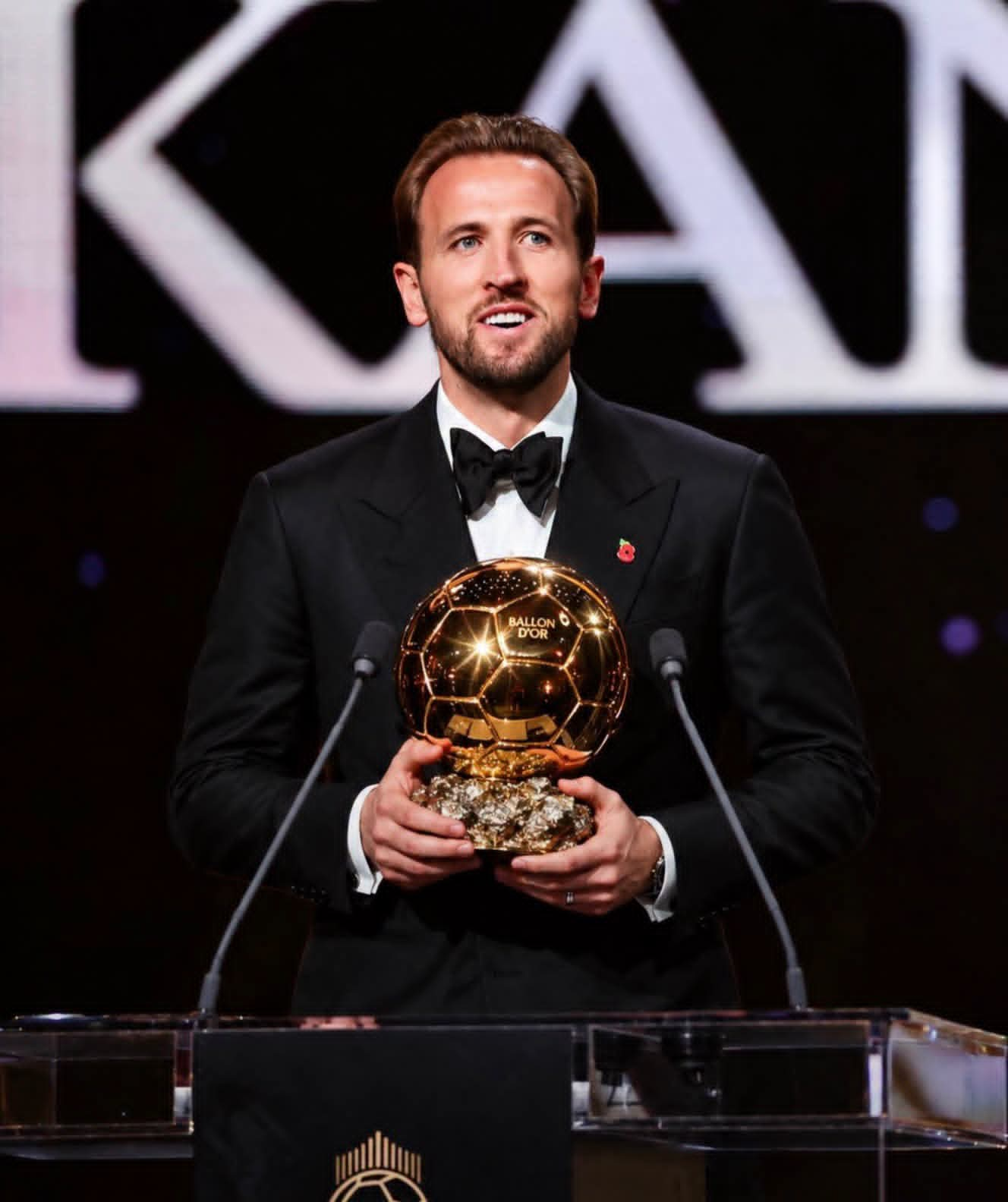
At 33, the England captain has reached the pinnacle of individual football honours after years of loan spells, painful final defeats and a long wait for major silverware. His story is a reminder that greatness does not always follow a straight path.
At 14, Harry Kane was still fighting to prove he belonged in elite football. At 17, he was learning the demands of senior football in England’s third tier. At 19, he was struggling for regular opportunities away from Tottenham Hotspur.
Four loan spells followed. Finals came and went without a trophy. For years, his goals kept coming, but the major honours that define successful team careers remained out of reach.
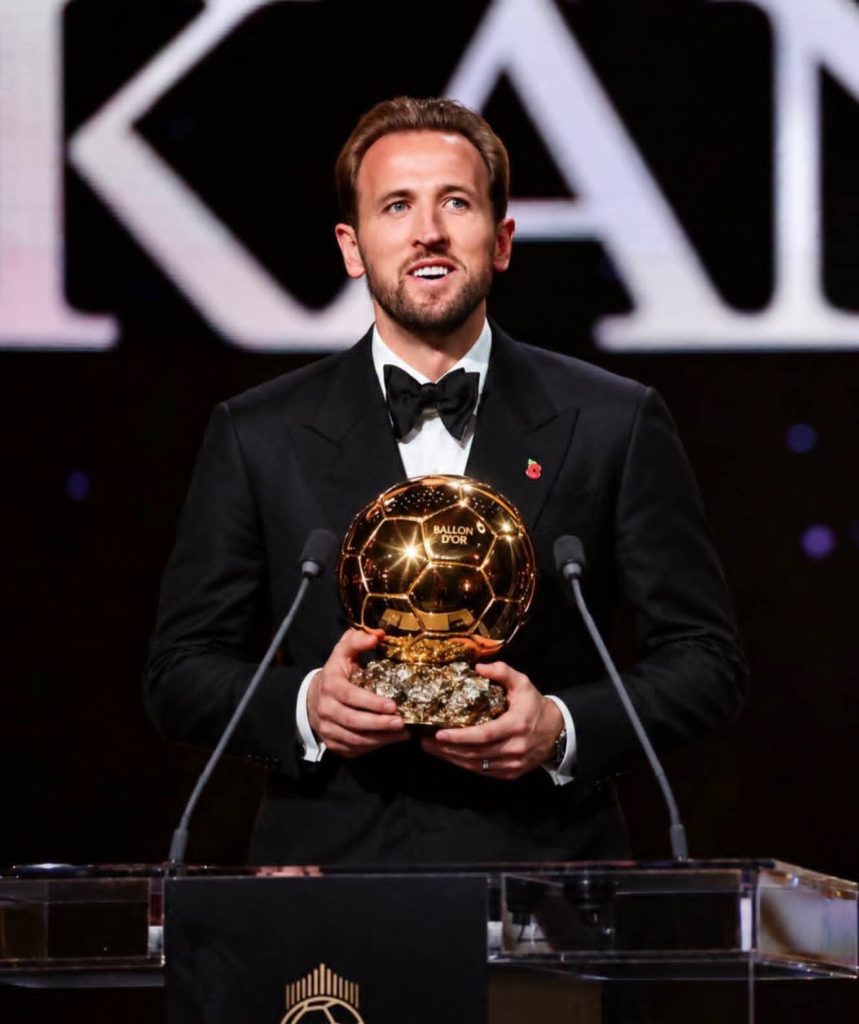
Then, on Monday, October 26, 2026, Kane completed a remarkable transformation, winning the Ballon d’Or at the age of 33 and becoming the first Englishman to claim football’s most prestigious individual award since Michael Owen in 2001.
The Bayern Munich striker’s triumph in London was the culmination of a journey that began long before he became one of the most prolific forwards in European football.
It was also recognition of a season in which his goalscoring ability translated into collective success, ending the argument over whether his individual brilliance could be matched by team achievements.
Rejection before recognition
Kane’s journey was far from straightforward.
As a young footballer, he initially joined Arsenal’s academy but was released at the age of eight. Watford also turned him away before Tottenham gave him another opportunity at 11.
He eventually established himself in Tottenham’s youth system, scoring 18 goals in 22 appearances for the Under-18s during the 2009/10 season. Yet a place in the senior team was never guaranteed.
In January 2011, Kane joined Leyton Orient on loan, taking his first significant steps into senior football in League One, England’s third tier.
He scored five goals during his spell at the club, gaining experience against older, stronger opponents in a competition where reputations mattered less than performances.
The next assignments took him to Millwall, Norwich City and Leicester City. At Millwall, he scored nine goals and won the club’s Young Player of the Year award. His subsequent spell at Norwich was disrupted by injury, while his time at Leicester brought limited opportunities to establish himself.
Four loan spells in three seasons could easily have become a sign that he was not going to make it at Tottenham.
Instead, they became part of his education.
According to his official career account and BBC reporting, those experiences exposed him to different tactical systems, demanding environments and the physical realities of senior football. They also delayed his breakthrough at the club where he had hoped to build his career.
Tottenham gave him the platform
Kane finally began to make his mark in Tottenham’s first team during the 2013/14 season.
His decisive breakthrough came under Tim Sherwood, who gave him a Premier League start against Sunderland in April 2014. Kane scored and followed it with goals against West Bromwich Albion and Fulham.
The following campaign transformed his career.
Under Mauricio Pochettino, Kane scored 31 goals in all competitions, including 21 in the Premier League. He won the league’s Golden Boot in 2015/16 and 2016/17, then scored 41 goals across all competitions in 2017/18.
He was no longer a youngster trying to convince his club that he deserved a chance. He had become one of the most reliable goalscorers in England.
Kane also developed beyond the traditional role of a centre-forward. His ability to drop deep, link play, create chances and deliver accurate passes made him a complete attacking player rather than simply a finisher.

In 2020/21, he won both the Premier League Golden Boot and Playmaker awards, demonstrating his influence as both a scorer and creator.
In February 2023, he surpassed Jimmy Greaves to become Tottenham’s all-time leading goalscorer. He eventually left north London with 280 goals in 435 competitive appearances.
But the individual records could not erase the disappointment of departing without a major team trophy.
The finals that defined the wait
Kane’s career was increasingly marked by the contrast between personal excellence and collective disappointment.
Tottenham reached the 2019 UEFA Champions League final but lost 2-0 to Liverpool. The club had come within one match of European glory, only to fall short at the final hurdle.
At international level, Kane captained England to the European Championship finals in 2021 and 2024. England lost to Italy on penalties in the first and Spain in the second.
Tottenham also lost the League Cup finals in 2015 and 2021.
These defeats created the familiar image of Kane as a prolific striker who could win individual awards but had yet to lift a major senior team trophy.
That narrative, however, needs perspective. Reaching major finals is itself evidence of sustained excellence, and football is a collective sport in which one player cannot determine every outcome.
Kane continued to score, break records and lead England despite the disappointment.
His first major team trophy finally arrived in May 2025, when Bayern Munich were crowned Bundesliga champions. The German club had initially endured a trophyless campaign after his arrival in 2023, making the eventual breakthrough especially significant.
The wait had ended, but the biggest individual honour of his career was still to come.
Bayern Munich changed the story
Kane joined Bayern in August 2023, leaving Tottenham in a transfer that offered him a new opportunity to compete for major honours.
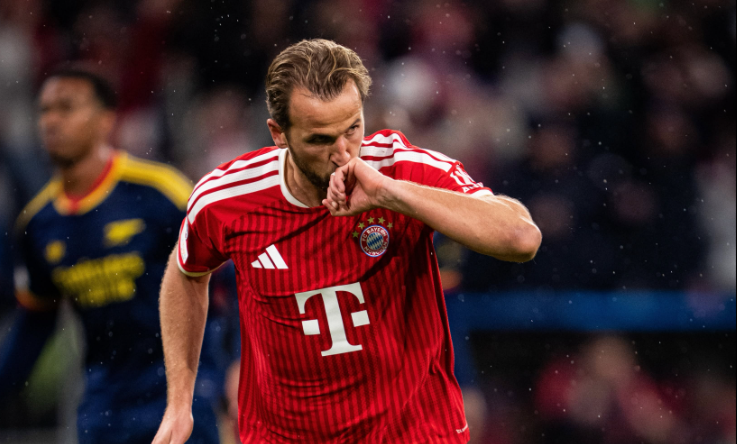
His first Bundesliga season was outstanding. He scored 36 league goals in 32 appearances, setting a record for a newcomer to the competition, although Bayern finished without a major trophy that campaign.
The following season brought the Bundesliga title in 2025. Kane then helped Bayern win further domestic honours, including the 2026 German Cup and Super Cup.
His move to Germany did not merely provide access to a more successful team. It placed him in a system where his finishing, movement, passing and decision-making could influence matches at the highest level while competing for silverware.
By the end of the 2025/26 season, his contribution was difficult to overlook.
Kane scored 61 goals in 51 competitive appearances for Bayern and added 12 for England, taking his total to 73 goals in 65 matches for club and country.
He also helped England finish third at the 2026 World Cup, scoring six goals during the tournament.
The combination of extraordinary scoring numbers, major trophies and international performances strengthened his case for the Ballon d’Or.
Why Kane won the Ballon d’Or
The 2026 award was not simply a reward for longevity or a sentimental recognition of a player who had waited years for success.
It reflected the scale of Kane’s performance during the period considered for the award.
His 61 goals for Bayern made him one of the most productive forwards in European football, while his 12 England goals demonstrated that his influence extended beyond club competition.
The Bundesliga title and domestic cup success also addressed a longstanding criticism of his career: the absence of major team honours.
Kane became the fifth Englishman to win the men’s Ballon d’Or, following Stanley Matthews in 1956, Bobby Charlton in 1966, Kevin Keegan in 1978 and 1979, and Owen in 2001.
He finished ahead of Kylian Mbappé and Lamine Yamal in the 2026 voting.
The result also underlined an important point about football’s biggest individual award. Spectacular talent and public attention can shape the conversation, but consistent production across an entire season, particularly when accompanied by team success, remains a powerful argument.
Kane had spent years producing elite numbers without receiving the same recognition as some of his more decorated contemporaries. His 2025/26 campaign finally brought those elements together.
A lesson in persistence, not overnight success
Kane’s achievement is compelling because it challenges the idea that a player must reach the summit early to be considered a great.
His career included rejection at Arsenal, uncertainty at Tottenham, difficult loan spells, major final defeats and a long wait for his first senior team trophy.
Yet he kept improving.
He became a more complete forward, learned to operate in different tactical systems and maintained an exceptional scoring record across multiple seasons. His development was gradual, and the rewards arrived in stages rather than all at once.
There is also a danger in reducing his journey to a simple story of adversity. Kane was already a celebrated Premier League striker long before winning the Ballon d’Or. His Tottenham years were not wasted seasons; they established the technical quality, consistency and leadership that later helped him succeed at Bayern.
Nor does winning the award at 33 mean he suddenly became the world’s best footballer at that age. Rather, the 2026 honour recognised a season in which his long-established abilities reached a new peak and were accompanied by the team achievements that had previously eluded him.
For young footballers, his story offers a more useful lesson than the promise that persistence automatically guarantees success. Hard work cannot eliminate every obstacle, and talent alone does not guarantee trophies. But patience, adaptability and sustained improvement can keep a career moving forward when the path appears uncertain.
At 14, Kane was still trying to establish himself. At 17, he was learning his trade in senior football. At 19, he was searching for opportunities. At 33, he stood on the stage in London holding the Ballon d’Or.
The journey was neither quick nor predictable.
But after years of goals without the ultimate recognition, Harry Kane finally has the individual honour that matches the extraordinary career he has built.

