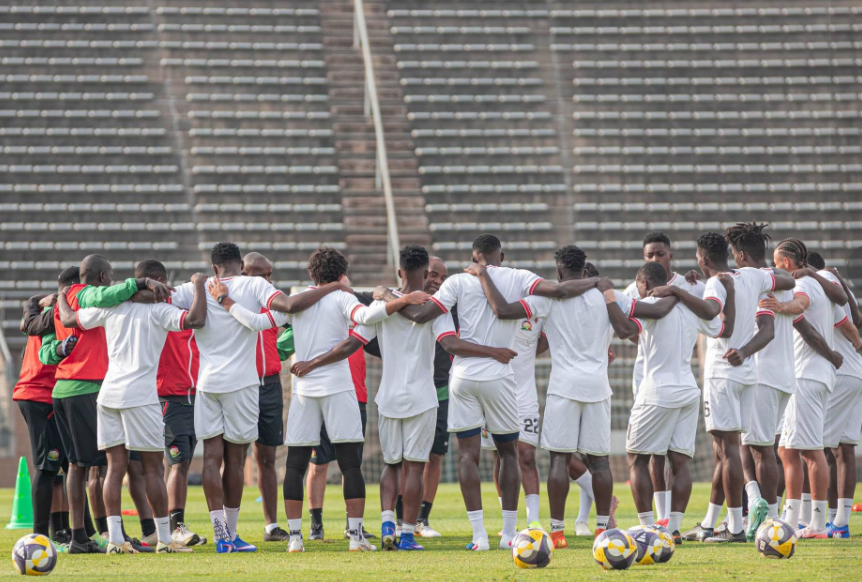
Benni McCarthy’s position as Harambee Stars head coach is facing fresh scrutiny after the South African revealed that he and members of his technical team have been working in Kenya without the required work permits, with the team’s disappointing start to the 2027 Africa Cup of Nations qualifying campaign adding to the pressure.
The former Manchester United forwards coach has raised concerns about administrative delays, unpaid player allowances and inadequate preparations, exposing problems that threaten to undermine his efforts to build a competitive Kenyan side ahead of the continental tournament that Kenya will co-host next year.
Although McCarthy has not announced an intention to leave, the combination of off-field difficulties and disappointing results has created an increasingly difficult environment for the coach.
Work permit dispute exposes cracks in the relationship with FKF
McCarthy’s revelation about his immigration status has emerged as one of the most serious issues surrounding his tenure.
In comments reported by The Star on September 24, the coach said he and members of his technical staff had yet to secure the documentation required to work in Kenya.
“I don’t want to be questioned by authorities on why I am in another country illegally,” McCarthy said
The coach also expressed frustration at what he perceived as a lack of urgency from those responsible for his employment.
“I have no reason to be here because I don’t have the legal documents to be here. While it is a big problem to me, it does not seem to be a problem for the people we work for,” he said.
The comments raised questions about the working relationship between McCarthy and Football Kenya Federation (FKF), particularly whether the federation had provided the administrative support necessary for him to carry out his responsibilities.
FKF subsequently acknowledged the problem, confirming that it was working with government agencies to process the documentation. The federation maintained that the matter was administrative and said it remained committed to supporting the technical team.
However, the unresolved issue has consequences beyond paperwork.
A national team coach is expected to monitor players, attend domestic matches, assess talent and build relationships with clubs throughout the country. McCarthy has indicated that the documentation problem has restricted his ability to remain in Kenya after international assignments, complicating those responsibilities.
For a coach attempting to develop a team ahead of a major tournament, such restrictions could undermine continuity and make long-term planning more difficult.
The dispute also raises a question of trust. McCarthy has publicly voiced concerns about his employers’ handling of a matter that directly affects his ability to work, putting pressure on FKF to demonstrate that it can resolve the situation.
Harambee Stars stumble in opening two matches

The off-field problems have coincided with a disappointing start to Kenya’s Group D campaign.
Harambee Stars opened their qualifying programme with a 1-1 draw against Eritrea at Nyayo National Stadium on Saturday, September 26 before suffering a 1-0 defeat to Guinea in Conakry on Thursday, October 1, 2026.
The draw against Eritrea was particularly frustrating for supporters. Kenya conceded in the 37th minute and needed Ogam’s late intervention to avoid defeat on home soil.
The result was made more concerning by the circumstances surrounding the team’s preparations. Players had protested over unpaid allowances, disrupting training ahead of the match.
McCarthy defended his players after the draw, arguing that the lack of preparation had affected their performance.
“I think when you don’t train for four days and you have to go into a match like this, you’re going to have a little bit of shortcomings,” he said.
The two results have strengthened concerns about whether the team is making sufficient progress under McCarthy, particularly with the 2027 tournament approaching.
Unpaid allowances have become another problem for McCarthy
The work permit controversy is not the only administrative challenge facing the coach.
McCarthy has also spoken about players going through several national team camps without receiving promised allowances, a situation that has affected morale and made it more difficult to manage the squad.
“For four to five camps, not receiving any cent of what was promised, of course, as a human being you will be like, is it worth it? Is it okay for the national team?” he said.
The frustration eventually spilled into preparations for the Eritrea match, with players protesting over outstanding payments and limiting the team’s training time.
That placed McCarthy in a difficult position. He was expected to produce a strong performance while dealing with circumstances that were largely beyond his control.
The coach’s challenge is therefore twofold: improve the team’s performances while trying to ensure that administrative and financial disputes do not continue disrupting preparations.
Yet the distinction between the problems facing the coach and his responsibility for results is unlikely to shield him indefinitely from criticism.
Supporters and football officials will ultimately want to see a team capable of competing against stronger African opposition, regardless of the difficulties behind the scenes.
Why McCarthy’s future is on shaky ground

Several factors could make McCarthy’s position increasingly difficult if the current situation persists.
A breakdown in confidence between coach and federation
Publicly expressing concern about the absence of work permits puts pressure on FKF to resolve the issue, but it also exposes a potentially uncomfortable relationship between the coach and the organisation employing him.
McCarthy has made clear that his legal documentation is a serious personal concern. FKF, meanwhile, has described the matter as an ongoing administrative process.
If the issue remains unresolved, it could become harder for both sides to maintain a productive working relationship.
A coach who lacks confidence in the administrative support available to him may struggle to plan effectively, while federation officials may come under pressure to justify the circumstances surrounding the appointment.
There is, however, no confirmed evidence that FKF has decided to dismiss McCarthy or that the coach has formally requested to leave.
Results are increasing the pressure
Two matches without a victory are not enough, on their own, to establish that a coach has failed. Nevertheless, the manner of Kenya’s start has increased scrutiny.
The draw against Eritrea exposed problems in finishing and preparation, while the defeat to Guinea demonstrated the difficulty of converting improved attacking efforts into points.
McCarthy now faces the task of demonstrating that the team can make measurable progress despite the disruptions.
Should the same weaknesses persist in subsequent matches and friendlies, questions about his tactical decisions, squad selection and overall direction will become more difficult to dismiss.
Expectations are rising ahead of AFCON 2027
Kenya will co-host AFCON 2027 alongside Uganda and Tanzania, meaning the Harambee Stars are already guaranteed a place at the finals.
That qualification security removes the immediate threat of missing the tournament, but it also creates a different form of pressure: Kenya must use the available preparation period to build a side capable of competing on home soil.
The Group D campaign still matters competitively. Under the special arrangement for host nations, the group winner and runner-up qualify alongside Kenya if the hosts finish first; otherwise, only the group winner joins Kenya from the group.
For McCarthy, the bigger concern is readiness for the finals. A poor run of performances could prompt questions about whether he is the right person to lead the team into a tournament in which expectations will be particularly high.
The coach risks being judged on problems he cannot solve alone
McCarthy’s situation illustrates a familiar difficulty in international football: the head coach is often held responsible for results even when important parts of the team’s preparation depend on administrators and government agencies.
The work permit delays and unpaid allowances are not tactical problems that can be corrected through training drills. They require intervention from FKF and the relevant authorities.

Nevertheless, the coach must still find ways to organise the squad, improve performances and maintain player confidence.
If administrative problems continue to undermine preparations, McCarthy could find himself caught between a federation expected to deliver a successful tournament and supporters demanding immediate improvement.
The case for giving McCarthy more time
There is also a strong argument against making a hasty decision about his future.
Kenya’s poor opening results came during a period of disrupted preparation, and McCarthy publicly pointed to the limited training time before the Eritrea match.
It would therefore be premature to attribute the team’s difficulties entirely to his coaching.
The South African also has an opportunity to use the remaining international fixtures to assess his squad, improve tactical cohesion and identify the players best suited to his system.
Furthermore, Kenya’s automatic qualification for AFCON 2027 means the immediate objective should be to build a competitive team rather than react to every disappointing result as though the country were about to miss the tournament.
The most constructive response would be for FKF to settle the outstanding administrative issues, ensure players receive their allowances and give the technical team a stable environment in which to work.
That would make it easier to assess McCarthy fairly on the football itself.
McCarthy’s future with Harambee Stars is under pressure because several problems have converged at the same time: an unresolved work permit dispute, concerns over player payments, disrupted preparations and a winless start to the AFCON 2027 qualifying campaign.
The most troubling aspect is not simply that Kenya have collected one point from their opening two matches. It is that the coach has publicly questioned the handling of basic administrative responsibilities while the team struggles to establish momentum.
Those circumstances could erode confidence between McCarthy and FKF, while poor performances risk increasing pressure from supporters and football stakeholders.
But his departure is not a foregone conclusion. The federation has said it is working to resolve the documentation issue, and the coach has cited preparation problems that help explain the opening results.
The decisive test will be whether FKF resolves the off-field problems and McCarthy can turn the remaining preparation period into visible improvement on the pitch. If the administrative issues persist and the team’s performances fail to improve, calls for a change in leadership could grow considerably louder before Kenya host AFCON 2027.