

President William Ruto is signalling a change in tone towards Kenya’s Gen Z, embracing the right to criticise government and peacefully protest as the country moves towards the August 2027 general election.
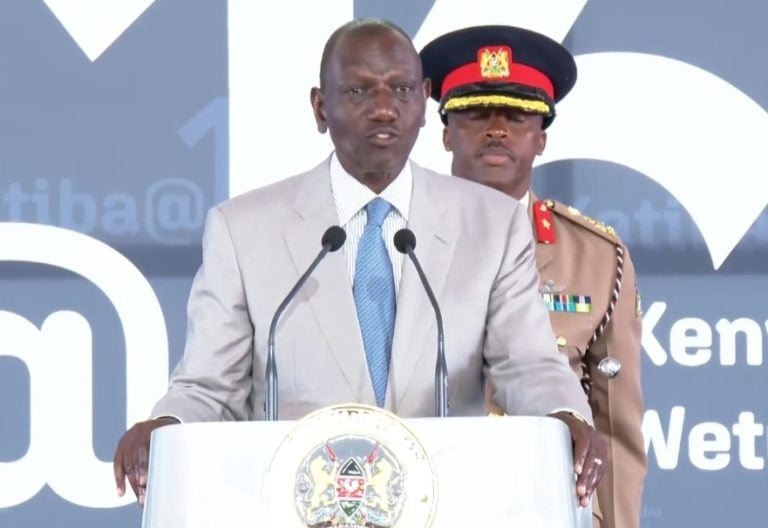
Speaking at Katiba Day celebrations on Thursday, August 27, 2026, Ruto said no Kenyan should lose their life, liberty or dignity for criticising the government, expressing an unpopular opinion or taking part in a peaceful demonstration.
“No Kenyan should lose their life, liberty or dignity merely for criticising government, expressing an unpopular opinion, or participating in peaceful demonstration,” Ruto said.
The message marks a notable shift from the political confrontation that followed the Gen Z-led protests of 2024, when young Kenyans took to the streets over proposed tax increases and wider concerns about governance and accountability.
Ruto acknowledged the pain left by those protests, saying some families had lost loved ones and that serious accusations had been made concerning unlawful arrests, enforced disappearances and excessive use of lethal force.
“I recognise the pain that remains from the events of that period,” he said.
He called for every credible claim of a human rights violation to be investigated independently, thoroughly and transparently, with those responsible held accountable where wrongdoing is established.
That puts accountability at the heart of Ruto’s latest attempt to reconnect with a generation that has repeatedly challenged his government.
From confrontation to courtship
The 2024 demonstrations began with opposition to the Finance Bill but quickly developed into a broader challenge to Ruto’s administration.
Young Kenyans used social media to organise protests across the country, with demands expanding beyond taxation to include concerns over corruption, the cost of living, governance and police conduct.
The protests reached a turning point on June 25, 2024, when demonstrators stormed Parliament. Ruto subsequently withdrew the Finance Bill, and the unrest led to a major political shake-up, including the dismissal of most of his Cabinet.
The security response also became a major source of controversy, with rights organisations documenting deaths, injuries, arrests and allegations of enforced disappearances.
Ruto’s language towards the movement has since evolved.
At Katiba Day, he said the 2024 demonstrations reflected young Kenyans exercising constitutional freedoms and seeking to make themselves heard.
That is significant because it places the protests within the constitutional framework Ruto was celebrating rather than treating dissent itself as a threat to the state.
The political calculation is also increasingly clear: the young Kenyans who helped force his government to retreat in 2024 remain an important constituency as the 2027 election approaches.
But the attempt to rebuild trust faces an unresolved obstacle: justice.

Justice remains a test
For families of people killed or reported missing during the protests, Ruto’s new language on constitutional rights does not settle questions about what happened.
Two years after the first major Gen Z demonstrations, families were still seeking answers over deaths and disappearances. Human Rights Watch’s 2026 reporting said at least 41 people linked to Kenya’s protests remained missing, including 26 from 2024 and 15 from 2025.
The Kenya National Commission on Human Rights (KNCHR) has also continued to document the claims involving security forces.
Following the June 25, 2026 demonstrations marking the second anniversary of the 2024 protests, the commission said it had documented seven incidents of enforced disappearance involving protesters. It said six people were arrested outside Parliament, taken away in a police vehicle and could not initially be traced through police stations.
Those allegations are not proof of wrongdoing by individual officers in every case, but they explain why Ruto’s call for independent investigations carries political weight.
The president said Kenya could not honour its Constitution by looking away from credible allegations of human rights violations.
That commitment creates a clear test for his government: whether investigations are seen as independent and whether proven abuses lead to accountability.
For Gen Z, that distinction may matter more than the language of the Katiba Day speech.
Rights, but with limits
Ruto did not offer an unconditional defence of protests.
He drew a line between peaceful demonstrators and people who commit crimes during demonstrations, saying the Constitution protects peaceful and unarmed assembly but does not protect arson, looting or lawlessness.
“We must neither criminalise protest because of the actions of a few, nor legitimise criminal conduct merely because it occurs in the course of a protest,” he said.
That position allows Ruto to defend the constitutional right to protest while maintaining that the government has a responsibility to protect public order and property.
But he also placed a responsibility on the authorities themselves.
“The duty to maintain order carries an obligation to respect life, dignity and the law,” he said.
And in a message that could resonate with the generation he is seeking to win back, Ruto added: “The authority to govern carries a responsibility to listen.”
The formulation is politically significant because it reverses the direction of the accountability argument. Protesters have a duty to remain peaceful, Ruto says, but government also has a duty to listen and respect the law when maintaining order.
The 2027 calculation
Ruto’s latest remarks come less than a year before the August 2027 election, giving the new emphasis on dialogue and constitutional rights an unavoidable political dimension.
The 2024 protests showed the power of Kenya’s young population to influence national politics without relying on established parties or traditional political leaders.
The movement forced the government to abandon the Finance Bill and contributed to a wider debate over the conduct of government and the use of force against protesters.
The government has since faced continuing scrutiny over alleged abuses. The issue was still live in June 2026, when rights groups and families marked the second anniversary of the 2024 protests while demanding accountability.
Ruto’s latest message therefore amounts to an apparent Gen Z charm offensive, but one that comes with a credibility test.
The president is now telling young Kenyans that they have a constitutional right to challenge government, that peaceful protest must be protected and that credible allegations of abuses must be investigated.
Those principles are difficult to separate from the experience of the same generation that demanded them in the streets.
The question before 2027 is consequently not simply whether Ruto can change his rhetoric.
It is whether his government can demonstrate that the principles he invoked at Katiba Day apply when citizens use their constitutional freedoms to challenge those in power.
That means credible investigations where abuses are reported, accountability where wrongdoing is established and a security response to dissent that respects life, dignity and the law.
Ruto is seeking to rebuild his relationship with Gen Z.
Whether that becomes a genuine political reset or an election-year attempt to repair damaged trust will depend less on the president’s latest words than on what his government does with them.