Dan Mackenzie, the eldest son of convicted Kenyan cult leader Paul Mackenzie, has revealed that his younger siblings were allegedly subjected to forced fasting as recently as two weeks ago, raising fresh concerns about the continued influence of the Shakahola cult’s teachings.
Dan, 27, said he reported the matter to the police, leading to the rescue of eight children, including his five younger siblings, from their grandmother’s home. The children were subsequently taken to a rescue centre.
According to Dan, the children had been denied food for nearly three days as part of the religious practices still followed by some members of his family.
The disclosure comes after a major court ruling against Paul Mackenzie and 28 other defendants in connection with the deaths of followers of the controversial religious movement based in Shakahola Forest, near Kenya’s coastal region.

Paul Mackenzie’s son reports alleged forced fasting
Dan said his decision to involve the authorities was driven by concern for the safety of his younger siblings, despite the difficult choice of reporting members of his own family.
He acknowledged that he initially defended his father when allegations about the scale of the Shakahola tragedy emerged. However, he said that following the court proceedings helped him understand the seriousness of the crimes and the suffering experienced by victims and their families.
“I had to report my grandmother,” Dan said, explaining why he chose to seek police intervention.
His account suggests that concerns about the welfare of children exposed to the movement’s teachings may persist even after the criminal proceedings against its leadership.
The rescue of the eight children has also highlighted the importance of identifying vulnerable minors who may remain exposed to harmful religious practices within family settings.
Dan Mackenzie recounts childhood under cult teachings
Dan said he experienced forced fasting during his own childhood, recalling an incident when he was approximately 12 years old.
He said he was made to go without food for almost a week and also remembered being beaten by church members for hours to compel him to attend a religious service.
The movement associated with his father prohibited formal education and portrayed modern medicine as evil, according to accounts presented in the case.
Dan said he left school when he was seven, a decision that reflects the impact the group’s teachings had on his childhood and access to education.
Paul Mackenzie’s followers were reportedly encouraged to reject conventional institutions and embrace extreme religious practices in preparation for what the preacher described as meeting Jesus.
Investigators and prosecutors linked these teachings to the deaths of followers who starved themselves or their children.
Shakahola massacre verdict marks major development
The court’s ruling against Paul Mackenzie and the other defendants represents a significant development in the prosecution of the deaths associated with the religious movement.
Mackenzie was convicted of murdering 190 children and one adult, while 28 other defendants were also convicted of murder.
The case centres on allegations that followers were instructed to starve themselves and their children to death to prepare for an anticipated encounter with Jesus.
During the proceedings, the court heard accounts of extreme coercion against those who resisted fasting. One of the accused reportedly told the court that Mackenzie had advocated forcing reluctant followers to heaven through physical violence.
Delivering her judgment in Mombasa, Justice Diana Mochache described how followers viewed Mackenzie as a messenger of Jesus.
The court also heard that burials in the forest were portrayed as weddings with Jesus, with deaths celebrated within the group’s religious framework.
The convictions represent a key milestone in a case that shocked Kenya and drew attention to the dangers posed by extremist religious movements operating outside effective oversight.
Shakahola investigation exposed hundreds of deaths
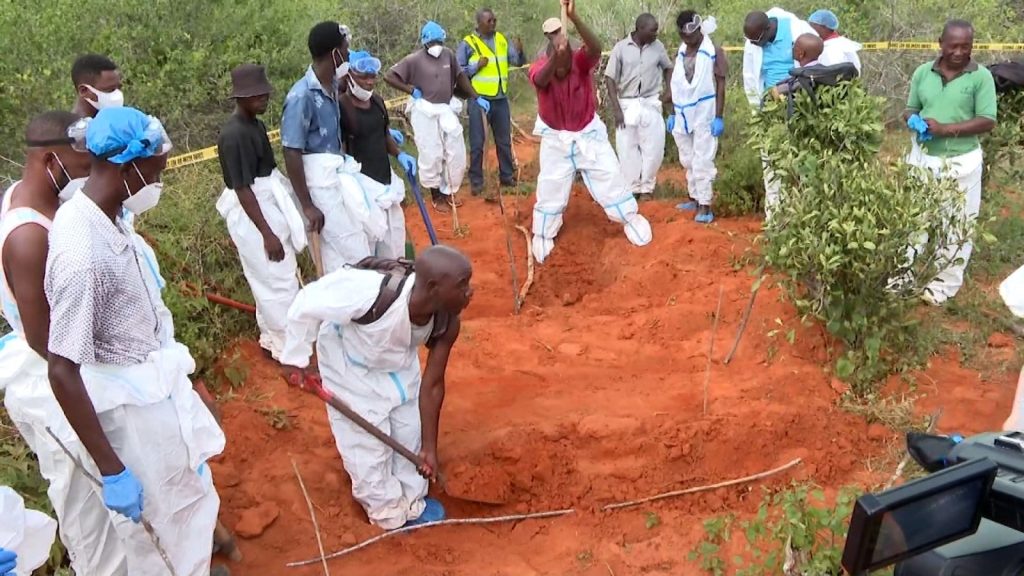
Paul Mackenzie was arrested in 2023 after investigators discovered bodies buried in shallow graves in Shakahola Forest, near Malindi.
The number of recovered bodies eventually exceeded 400, making the discovery one of Kenya’s most disturbing cases of suspected religiously motivated mass deaths.
Investigations focused on the alleged use of extreme fasting, the indoctrination of followers and the involvement of children in practices that exposed them to life-threatening deprivation.
The deaths also prompted wider questions about child protection, the monitoring of religious organisations and the ability of authorities to intervene when families are exposed to dangerous teachings.
Mackenzie and other members of the movement face separate proceedings relating to terrorism, radicalisation and the alleged denial of education to children. Those cases are distinct from the murder convictions.
Surviving families seek justice after Shakahola tragedy
The verdict has brought renewed attention to the families who lost relatives in the tragedy.
Stephen Mwiti, 48, who said all six of his children died after becoming involved with the movement, welcomed the convictions.
His former wife was among those convicted alongside Mackenzie, underscoring how the case has affected families whose members were drawn into the group.
For survivors and relatives of the dead, the ruling offers a measure of accountability after years of investigations and court proceedings.
Dan said he hoped the verdict would provide some comfort to people who lost friends and relatives.
He now lives in Malindi, where he earns a living as a motorcycle taxi operator while supporting himself and his younger siblings.
Dan said some residents had treated him negatively because of his father’s crimes, while others had accepted him after he distanced himself from the movement.
His decision to report the alleged mistreatment of his siblings marks a further break from the environment in which he grew up.
Child protection concerns remain in focus
The reported rescue of the children raises questions about whether other minors could still be exposed to dangerous practices linked to the Shakahola movement.
Child protection advocates and authorities face the challenge of identifying children at risk, ensuring access to food and education, and providing appropriate care for those removed from harmful environments.
The case also highlights the difficulties survivors may face when relatives continue to believe in teachings associated with a convicted religious leader.
For Dan, the priority is protecting his younger siblings and helping them avoid the experiences that shaped his own childhood.
The Shakahola tragedy has demonstrated the devastating consequences that can arise when religious authority is used to justify extreme deprivation and coercion.
Although the murder verdict represents an important step towards accountability, the recent allegations involving children suggest that safeguarding vulnerable families remains a pressing concern in coastal Kenya.