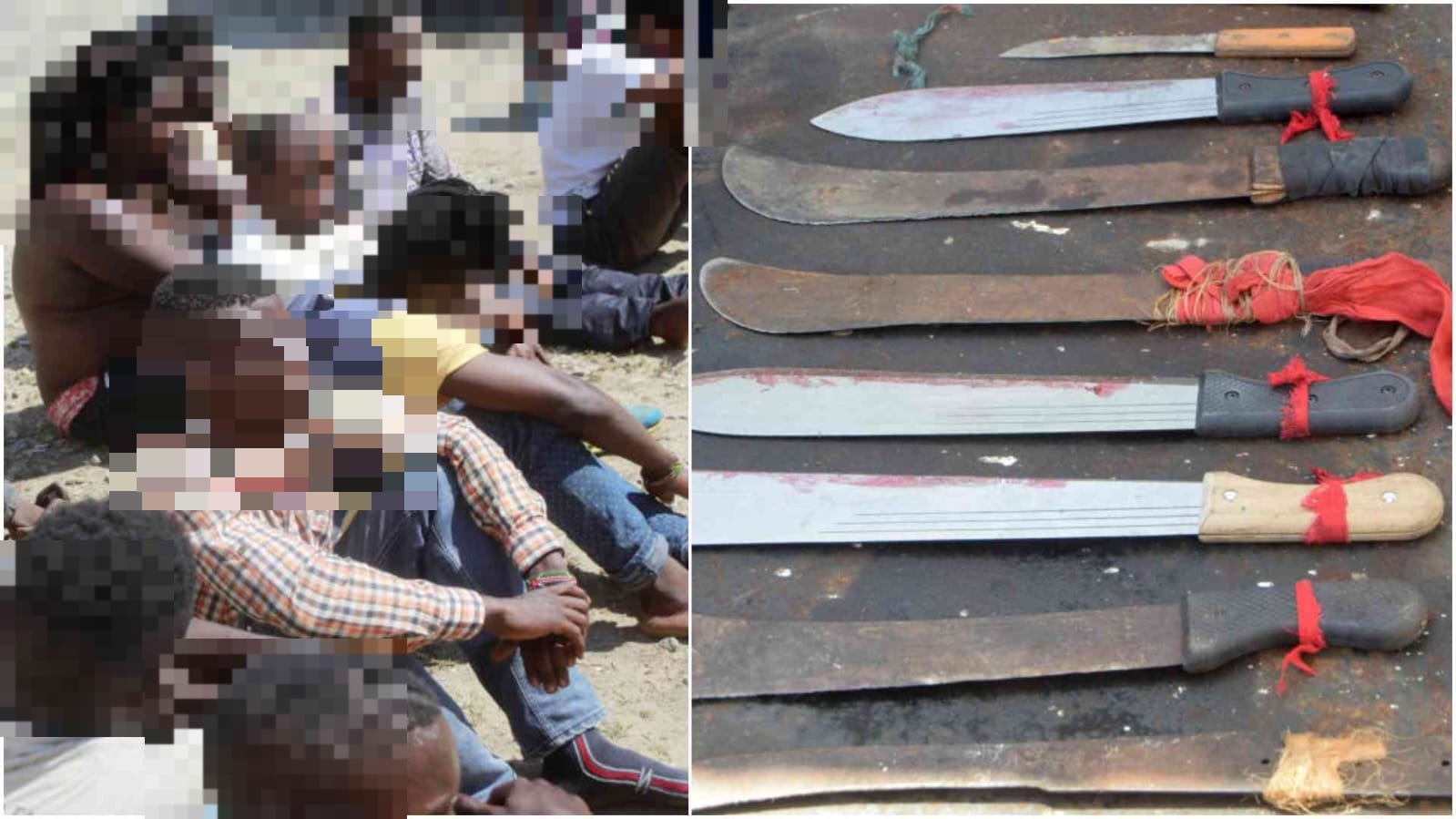

Kenyan law enforcement agencies recorded 1,316 arrests linked to organised criminal gangs in the year to August 2026, a 119 per cent increase from the previous reporting period, as a national security report identified 309 criminal gangs across the country.
The figures are contained in the 2025/2026 Annual Report on the State of National Security, which warns that organised criminal groups continue to pose a threat to public safety, national security, social cohesion and economic development.
The report covers the period between September 2025 and August 2026. It records 714 more arrests than the 602 made between September 2024 and August 2025.
However, the report cautions that some of the 309 gangs it recorded are dormant. The figure therefore represents gangs identified in the report, not necessarily 309 groups actively operating during the entire reporting period.
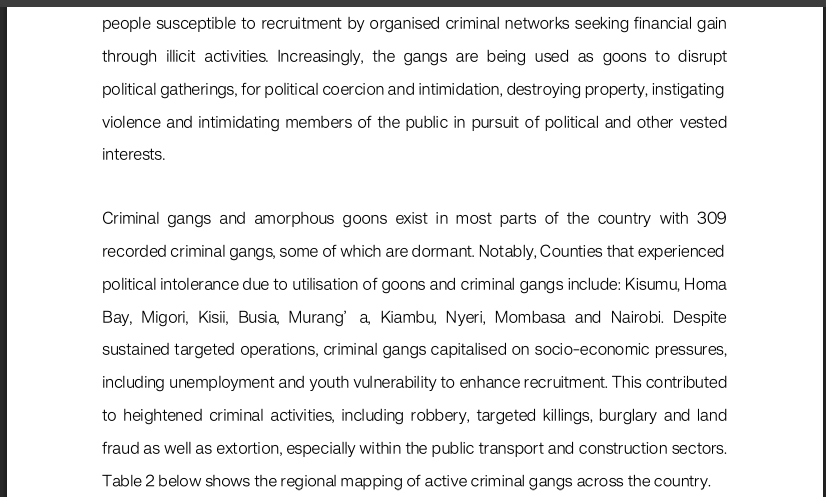
“Criminal gangs and amorphous goons exist in most parts of the country with 309 recorded criminal gangs, some of which are dormant,” the report states.
It attributes the increase in arrests to intensified security operations as well as the continued emergence and expansion of criminal gangs.
Panga Boys lead gang-related arrests
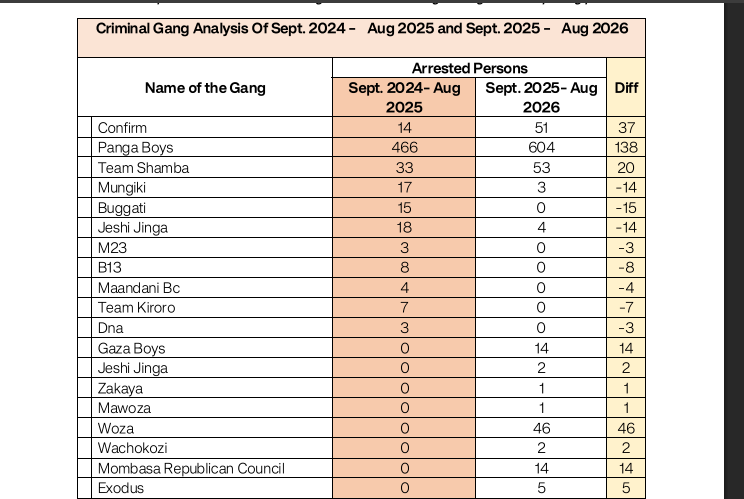
Panga Boys recorded the highest number of arrests in the report’s gang-by-gang comparison, with 604 people arrested during the 2025/2026 reporting period, up from 466 in the previous year.
Mbogi Mawe followed with 149 arrests, while Chafua recorded 94. Other groups included Team Nati Dread, with 47 arrests; Mbogi Mfalme Maziwa, 43; Team Wakali, 35; and Wagwana, 21.
The report also recorded arrests involving Confirm, Team Shamba, Woza, Jobless Boys, Gaza Boys and several other groups.
These figures represent arrests recorded by law enforcement agencies. They do not, on their own, establish that those arrested were convicted or that every person was found guilty of participating in organised criminal activity.

Report maps gangs across seven regions
The security report identifies criminal gangs in Nairobi, Eastern, Rift Valley, Western, Nyanza, Coast and Central regions.
Among the groups listed in Nairobi are Team Kazoo, Mujahideen, Matopeni Mafia, Usiku Sacco, Jeshi ya Allah, Mbogi Genje, Brixton Silent, Colombia Candy, Gaza and Tokyo Mafia.
In the Coast region, the report lists groups including Wakali Wao, Panga Boys, Mombasa Republican Council, Team Mashamba, Woza and Maandani BC.
It also identifies groups with reported presence in more than one county.
Gaza is listed in nine counties: Mombasa, Kwale, Nakuru, Kilifi, Isiolo, Machakos, Nairobi, Kiambu and Kisumu.
Mungiki is mapped in Nakuru, Machakos, Nairobi, Murang’a and Kiambu, while Panga Boys are listed in Kilifi, Kwale and Mombasa.
The report says the presence of some gangs across county boundaries demonstrates the wider reach of the security threat.
Political patronage and youth recruitment raise concern
Beyond conventional criminal activity, the report raises concern about the use of gangs and goons to disrupt political gatherings, intimidate members of the public, destroy property and instigate violence.
It identifies Kisumu, Homa Bay, Migori, Kisii, Busia, Murang’a, Kiambu, Nyeri, Mombasa and Nairobi among counties that experienced political intolerance linked to the use of goons and criminal gangs.
The report also links gang recruitment to unemployment and the vulnerability of young people to criminal networks seeking financial gain.
It says gang-related activities include robbery, targeted killings, burglary and land fraud, as well as extortion, particularly in the public transport and construction sectors.
Political patronage is identified as one of the main obstacles to tackling the groups. Other challenges include the proliferation of illicit firearms, recruitment of vulnerable people, fear of retaliation that limits intelligence sharing, movement of gang members across counties and the use of digital platforms to coordinate criminal activities.
The report also points to limited rehabilitation and reintegration programmes as a challenge in efforts to dismantle criminal networks.
Government targets gang financiers and recruitment networks
The Government says it has intensified intelligence-led, multi-agency operations targeting gang leaders and members, increased police patrols in crime hotspots and strengthened surveillance and intelligence gathering.
Other interventions include community policing, efforts to dismantle emerging gangs and investigations into people financing or facilitating organised criminal activities.
The report also cites youth empowerment initiatives. It says 10,364 young people and 600 youth leaders were sensitised, 51,000 received training in social-emotional skills, while 91,000 received the first tranche of grants under the NYOTA project.
Going forward, the Government says it will target not only gang members but also financiers, protectors and operational networks.
It has pledged to strengthen community policing, improve monitoring of digital platforms used to mobilise goons, fast-track prosecutions and establish a centralised national database of organised criminal gangs.
The report also says the Government intends to enforce laws governing political parties and elections, as well as constitutional provisions on leadership and integrity, to deter politicians from supporting goonism.
The rise in arrests points to increased enforcement activity, but the report’s own assessment highlights the wider challenge: dismantling criminal networks will require action against recruitment, financing, political protection and the movement of gangs across county boundaries.