Kiambu Senator Karungo Wa Thang’wa has challenged the proposed Tertiary Education, Placement and Funding Bill, 2026, warning that its loan-based financing framework could shift more of the cost of higher education from households to graduates.
Thang’wa’s concerns centre on the proposed Tertiary Education Funding Authority (TEFA), which would replace the Higher Education Loans Board (HELB), the Universities Fund and the TVET Funding Board. The Bill would give the new authority responsibility for student financing, scholarships and loan recovery.
Parliament has begun nationwide public participation on the Bill, with the National Assembly Education Committee holding its first forums in September.
“This is a debate about who pays, who benefits, and whether the poorest child is protected first.”
Scholarships versus loans
The senator’s main objection is the financing balance between scholarships and loans.
He points to the 2023 Presidential Working Party on Education Reform, which proposed a Variable Scholarship and Loan Funding Model. Under that model, a vulnerable student would receive 82 per cent of funding through a scholarship and 18 per cent through a loan, while an extremely needy student would receive 70 per cent as a scholarship and 30 per cent as a loan.
A needy student would receive 53 per cent through a scholarship, 40 per cent through a loan and seven per cent from the family.
“The principle was simple. The poorer the child, the smaller the debt.”
Thang’wa contrasts that proposal with Clause 44 of the Bill. The provision establishes the Tertiary Education Fund and states that its purpose is to provide money to be granted as education loans.
The Bill also provides for scholarships and gives TEFA responsibility for administering them, but, according to Thang’wa, it does not set statutory scholarship percentages for different categories of students.
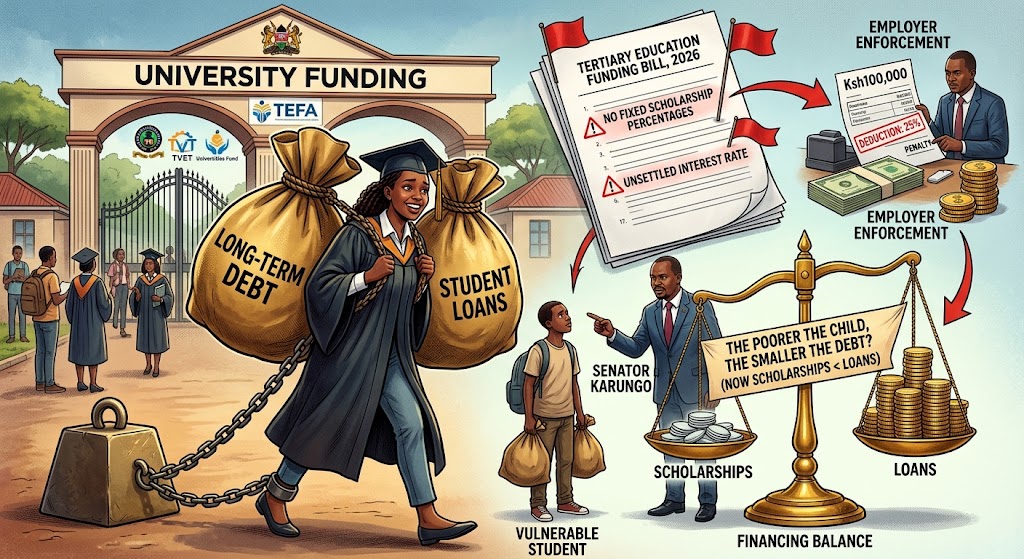
The Bill separately gives TEFA power to establish funding criteria in consultation with the Education Cabinet Secretary. Reporting on the legislation has also noted that it does not itself specify a fixed loan-to-scholarship formula.
For Thang’wa, the distinction is significant because students from families able to pay privately could graduate without government-loan obligations, while students who depend on government financing could accumulate debt.
“The same loan does not weigh the same on the child of a professional as on the child of a subsistence farmer.”
Debt follows graduation
The Bill would create a formal mechanism for recovering education loans from graduates.
Clause 49(4) provides that TEFA cannot deduct more than 25 per cent of a loanee’s emoluments when recovering an education loan. The Bill also requires borrowers in formal employment to disclose their loan status to employers, who would then make and remit the deductions.
The 25 per cent figure is a ceiling, not an automatic deduction imposed on every graduate.
“Twenty-five per cent is the maximum, not an automatic deduction for every graduate.”
The Bill further provides that repayment begins within one year after completion of studies and includes the principal, applicable interest and charges. For self-employed borrowers, it provides for a payment plan with the Authority.
Thang’wa argues that the provision raises questions for graduates who complete university without immediately finding work, because the Bill does not frame the one year simply around securing employment.
He illustrates the potential impact using a graduate earning Ksh100,000 a month. At the statutory maximum, Sh25,000 could be deducted for loan repayment. His calculation is presented as an illustration rather than a prediction of what every graduate would pay.
The Bill also provides employers with a role in enforcement. They must remit deductions within nine days after the end of each month, while failure to remit deducted money attracts a five per cent penalty for each month, or part of a month, that the money remains unpaid.
Interest remains unsettled
Thang’wa also questions the cost of borrowing under the proposed system.
The Bill does not state a fixed student-loan interest rate. Instead, TEFA would determine the rate in consultation with the Cabinet Secretary.
“This Bill contains no rate and no cap.”
That contrasts with the four per cent undergraduate HELB rate cited in the Presidential Working Party report and raises a separate question about how much borrowers would ultimately repay.
Thang’wa uses medicine to demonstrate the possible scale. Drawing on figures from the Working Party, he puts a pre-clinical medical year at Ksh360,000 and a clinical year at Ksh720,000. Three years of each would amount to about Ksh3.24 million before interest.
If the entire amount were financed through loans, repayment at Sh25,000 a month would take more than 10 years before interest and other charges.
“This is an illustration, not a prediction. But the lesson is clear. The more expensive the dream, the bigger the debt.”
Who finances the fund?
The Bill proposes a funding authority with powers extending beyond ordinary government appropriations.
TEFA would be able to mobilise resources through Treasury bills, bonds, concessional loans, government grants, savings schemes, unit trusts, commercial partners and loan repayments. It could also mobilise private capital from sources including pension funds, collective investment schemes and sovereign wealth funds.
The Bill also allows the Authority to establish a savings scheme through which individuals could deposit money towards tertiary education for a specific child.
Thang’wa distinguishes those financing powers from a direct claim that the Bill authorises securitisation of student loans.
“The Bill does not expressly say student loans will be securitised, and I will not claim it does.”
His concern is instead about the financial risks that could arise if future loan repayments are used to support borrowing or other financing arrangements.
The senator wants Parliament to clarify the scholarship protection available to vulnerable students, the applicable interest rate, when repayment begins for unemployed graduates, how deductions below the 25 per cent ceiling will be determined and whether future student-loan repayments could be pledged as part of financing transactions.
“Every child deserves to know whether that funding is a gift or a debt.”
The Bill is currently before Parliament and undergoing public participation, meaning its provisions remain subject to the legislative process and possible amendment.