

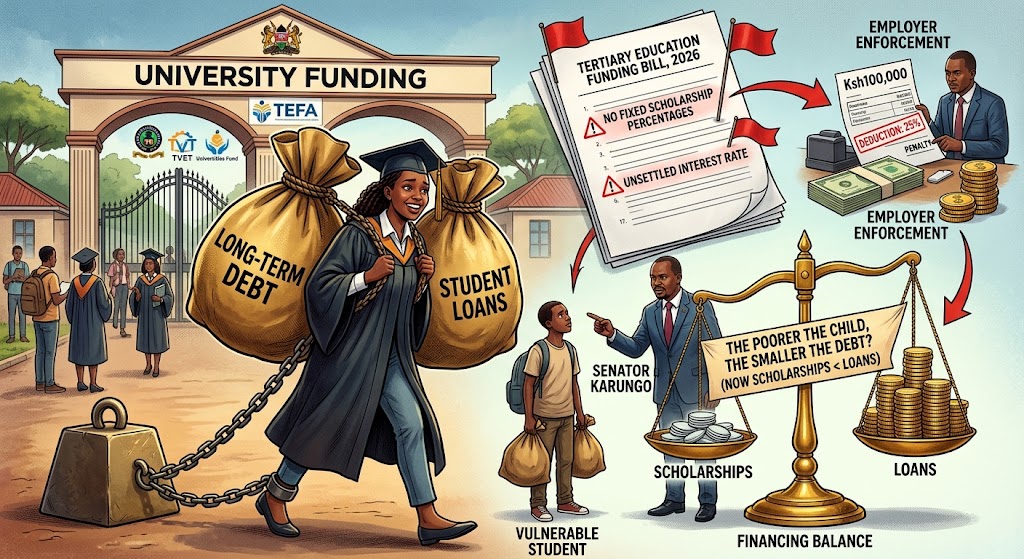
A graduate earning Ksh100,000 a month could face a student-loan deduction of up to Ksh25,000 under Kenya’s proposed Tertiary Education, Placement and Funding Bill, 2026, bringing the cost of university education directly into the payslip.
But the proposed 25 per cent deduction is a maximum ceiling, not an automatic charge on every graduate.
The distinction is important as Parliament considers the Bill, which proposes a new framework for financing tertiary education and recovering student loans.
Kiambu Senator Karungo Wa Thang’wa has focused on Clause 49, which provides for recovery of loans from a borrower’s emoluments. In his statement, he argues that the provision deserves closer scrutiny because a graduate’s education debt could continue to affect their income after leaving university.

The 25% ceiling
Clause 49 allows deductions of not more than 25 per cent of a loanee’s emoluments. The provision therefore establishes an upper limit rather than prescribing a flat 25 per cent deduction for every borrower.
Karungo says the definition of emoluments is particularly significant because it covers salary, allowances and bonuses.
“Clause 49 allows loan deductions of up to twenty-five per cent of emoluments, and the Bill counts salary, allowances and bonuses.”
The senator illustrates the possible effect using a graduate earning Ksh100,000 per month. At the maximum rate, 25 per cent would amount to Ksh25,000.
His calculation then considers other statutory deductions. He estimates that after PAYE, NSSF, SHIF and the Housing Levy, approximately Ksh70,000 could remain. A Ksh25,000 loan deduction would reduce that amount to about Ksh45,000.
That is Karungo’s illustration, rather than a universal calculation for every employee earning Ksh100,000.
From campus to payslip
The significance of the proposal lies in what happens after graduation.
For students who finance their education through loans, the debt does not end when they leave university. Once repayment becomes due, deductions from earnings could become one of the mechanisms used to recover the money.
Karungo captures that transition in his statement:
“Now let us follow that debt out of the lecture hall and into a payslip.”
The maximum deduction would vary according to income. At 25 per cent, Ksh40,000 in monthly emoluments would produce a maximum deduction of Ksh10,000, while Ksh60,000 would produce a maximum of Ksh15,000.
For a Ksh100,000 income, the ceiling would be Ksh25,000.
The figures demonstrate the potential scale of the provision, but they do not establish what an individual borrower will actually pay each month.
Who sets repayment?
That question is central to the debate because the Bill’s 25 per cent figure is only the upper limit.
Karungo wants clarity on how deductions below that ceiling would be determined.
“Fourth: how will deductions below the twenty-five per cent ceiling be set?”
The eventual repayment amount would depend on the framework established by the Authority, as well as factors such as the size of the loan, applicable interest and repayment period.
This means two graduates earning similar salaries could potentially have different repayment obligations depending on their individual loan circumstances.
The senator is also questioning when repayment would begin, particularly for graduates who leave college without securing employment.
“Third: when does repayment begin, and what happens to a graduate who has no job?”
That question points to an issue beyond the 25 per cent ceiling: the relationship between repayment and a graduate’s ability to earn.
The debt beyond graduation
Karungo’s concerns extend beyond the monthly deduction itself. His statement examines how the proposed financing system would treat student loans and the money recovered from borrowers.
The Bill provides for loan repayments and interest to flow into the Fund and gives the Authority powers to raise funds through various financial arrangements. Karungo also raises questions about proposals discussed around the broader financing of student loans, while distinguishing those discussions from what is expressly contained in the Bill.
His central concern is that students should understand the financial obligation they are taking on before accessing the proposed funding system.
“Every child deserves to know whether that funding is a gift or a debt.”
For graduates, the immediate issue is therefore not simply whether the law contains a 25 per cent figure.
It is how that ceiling will be applied, when repayment will begin, how deductions below the maximum will be calculated and what happens to borrowers who struggle to find or retain employment.
The proposed law would put the maximum deduction at 25 per cent of emoluments. The actual amount deducted from an individual graduate’s pay would depend on the repayment framework ultimately established under the new system.