

Kenya’s Gold Processing Bill, 2023 seeks to create a dedicated legal and institutional framework for the country’s gold industry, from collection and refining to transportation and marketing.
The Bill, sponsored by Ikolomani MP Bernard Shinali, proposes the creation of a Gold Processing Corporation to oversee the sector. Parliament began debating the Bill in 2025.
Importantly, the Bill is a proposed law, not an Act currently in force.
A new gold regulator
At the centre of the proposal is the Gold Processing Corporation.
The proposed corporation would regulate activities including collecting, sampling, purifying, smelting, refining, fabricating, registering, monitoring, and transporting gold and gold products.
It would also develop national standards for gold processing, regulate refineries, and facilitate international accreditation of gold processing facilities.
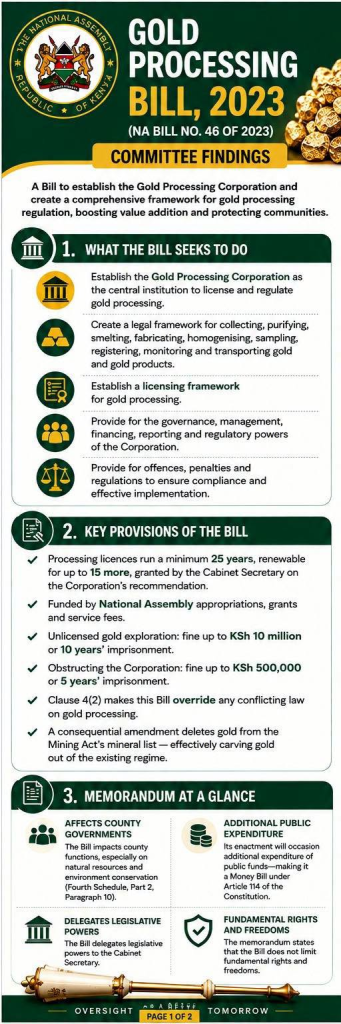
In simple terms, Kenya would have a specialised institution responsible for overseeing what happens to gold after it is extracted.
What changes for miners
The Bill seeks to formalise more of Kenya’s gold value chain.
It proposes licensing for gold processing and establishes rules covering the handling and movement of gold. The aim is to bring more activities into a regulated system and improve traceability.
The sponsor has argued that proper regulation could attract investment, increase foreign exchange earnings and ensure more of the value created by gold remains in Kenya.
The proposal also seeks to align Kenya’s gold processing standards with international standards.
Why the Bill matters
Kenya has gold deposits in areas including Kakamega, Migori and parts of Turkana.
The proposed framework could encourage local refining and processing instead of leaving the country with mainly raw mineral production.
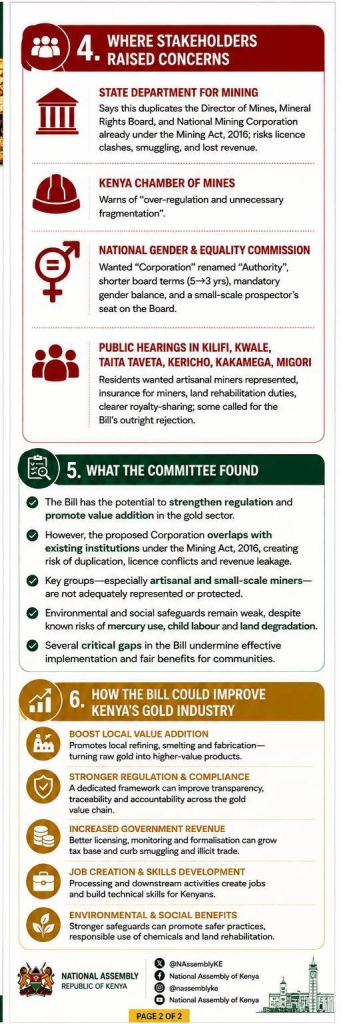
That could create jobs, develop technical skills, and potentially increase government revenue through licensing, taxation, and greater formalisation of the industry.
The Bill also seeks to address environmental and safety concerns associated with mining and processing.
The big concerns
The parliamentary committee identified several problems with the proposal.
One major concern is duplication. The proposed corporation could overlap with institutions and functions already established under the Mining Act, 2016, creating possible conflicts over licensing, regulation, and revenue collection.
The committee also raised concerns about inadequate representation of artisanal and small-scale miners, as well as weaknesses in environmental and social safeguards.
Stakeholders have warned that creating another institution could lead to overregulation and unnecessary fragmentation.
What it could mean
If enacted in its proposed form, the Bill would significantly reshape how Kenya regulates its gold industry.
The intended outcome is a more formal, traceable, and locally processed gold sector, with greater economic benefits for the country and mining communities.
But Parliament still has to address concerns over overlapping institutions, protection of small-scale miners, and environmental safeguards.
The central question is therefore not simply whether Kenya should regulate gold, but whether the proposed system can regulate it without creating another layer of bureaucracy.