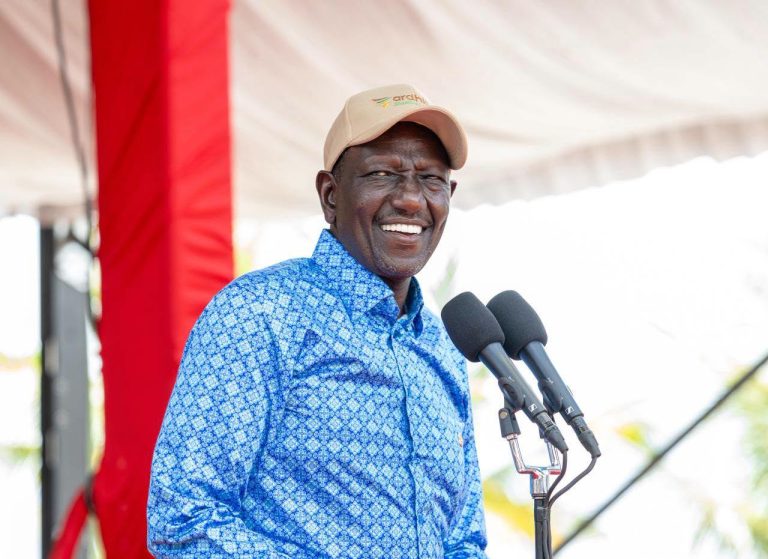
President William Ruto has defended his administration’s economic record, citing a doubling of Kenya’s stock market value to Ksh4.2 trillion, increased foreign direct investment and expanded access to credit as key achievements during his Mashujaa Day address in Eldoret.
Speaking on Tuesday, October 20, 2026, during the Mashujaa Day celebration in Eldoret, Ruto said his government had made progress in stabilising the economy, supporting businesses and increasing agricultural production since taking office in 2022.
“Over the last four years, we have grown our economy, stabilised our exchange rates, brought inflation under control, expanded access to credit, and reformed our capital markets,” the President said.
He said the value of Kenya’s stock market had risen from Ksh2 trillion in 2022 to Ksh4.2 trillion, while foreign direct investment had increased from $1.5 billion in 2022 to $3.2 billion in 2025.
The President also described Kenya as the seventh-largest economy in Africa, presenting the figures as evidence of improved investor confidence and the government’s economic reform agenda.
The claims place capital markets, investment and access to financing at the centre of the administration’s case that its policies are strengthening the business environment.
Stock market doubles
Ruto said the government had pursued reforms intended to improve the financial system and expand financing opportunities for businesses, including small enterprises that traditionally struggle to secure affordable loans.
“Credit to the private sector has expanded,” he said, pointing to increased lending and changes in the capital markets as indicators of economic progress.
The President also highlighted the Hustler Fund, a government-backed credit initiative targeting individuals and small businesses that have limited access to conventional bank loans.
According to Ruto, more than 10 million Kenyans were regular borrowers under the programme, with Ksh98 billion advanced without collateral.
He added that the government planned to inject another Ksh5 billion into the fund before the end of 2026 to expand access to credit and support additional businesses.
The proposed allocation would extend the administration’s efforts to use public-backed financing to reach borrowers who may not meet traditional lending requirements.
However, the number of borrowers and the amount disbursed do not, on their own, establish how much financing has translated into sustainable businesses, job creation or higher household incomes. Those outcomes depend on factors including repayment performance, business survival and the cost of borrowing.
Ruto’s investment figures also underscore the importance of distinguishing between announced investment commitments and actual capital inflows when assessing the performance of the economy.
Farmers gain from reforms
Agriculture featured prominently in the President’s account, with Ruto arguing that lower input costs and improved producer prices were helping farmers increase output and earnings.
He said the government had registered 8.9 million farmers, expanded access to subsidised fertiliser and taken measures against exploitative middlemen and cartels.
“Today, it costs 2,000 shillings under our subsidy programme,” Ruto said, referring to the price of a bag of fertiliser. He said the government had distributed more than 38 million bags under the subsidy initiative.
The President reported that maize production had increased from 34.3 million bags in 2022 to 71 million bags in 2025, while maize imports had declined from 9.9 million to 3.3 million bags, according to his address.
The reported changes are significant for Kenya’s food market, where domestic harvests influence the availability of maize, the cost of imports and pressure on household food budgets.
Ruto also cited higher producer prices in the coffee and tea industries. He said coffee cherry prices had risen from about Ksh70 to between Ksh110 and Ksh150 per kilogramme, while tea green-leaf prices had increased from Ksh35 to Ksh56 per kilogramme.
In the dairy industry, the President announced that farmers supplying New Kenya Cooperative Creameries (New KCC) would earn Ksh65 per litre from October 2026, alongside a quarterly bonus of Ksh2 per litre.
He said the changes were intended to improve farmers’ earnings and strengthen the agricultural value chain.
For businesses operating in agriculture, improved farm incomes can support spending on inputs, transport, processing and other services. The overall economic impact, however, will depend on whether higher producer prices are sustained and whether gains reach farmers after production and operating costs.
Export markets expand
The President also pointed to trade agreements as part of the government’s strategy to increase export opportunities for Kenyan producers and manufacturers.
He cited the economic partnership agreement with the European Union, which entered into force in 2024, and a comprehensive economic partnership agreement signed with the United Arab Emirates in 2025.
Ruto said Kenya was also opening new markets in China while seeking to maintain access to the American market through an extension of the African Growth and Opportunity Act (AGOA), alongside negotiations for a broader trade agreement with the United States.
“ We have also expanded international markets for Kenyan agricultural products,” he said, outlining the administration’s efforts to widen opportunities for exporters.
Preferential market access can help Kenyan businesses compete internationally, but the benefits depend on their ability to meet product standards, maintain reliable supply chains and deliver goods at competitive prices.
The President’s address presented investment, credit, agricultural production and export expansion as interconnected pillars of Kenya’s economic strategy.
The next test for the government will be whether the reported gains translate into sustained private-sector investment, stronger business activity, job creation and lower living costs for households.
While the figures outlined in Eldoret provide the administration’s assessment of its economic record, their broader significance will depend on independently verifiable data showing how the changes have affected businesses, workers and consumers.