Former US President Barack Obama has accused President Donald Trump’s administration of politically targeting Democratic Congresswoman Ilhan Omar, warning that efforts to challenge her citizenship could undermine fundamental principles of American democracy.
In a statement on Sunday, October 18, 2026, Obama argued that the government must not use its authority to punish elected officials for their political beliefs or criticism of the president. He described the alleged action against Omar, a Minnesota representative and prominent critic of Trump, as an alarming example of political intimidation.
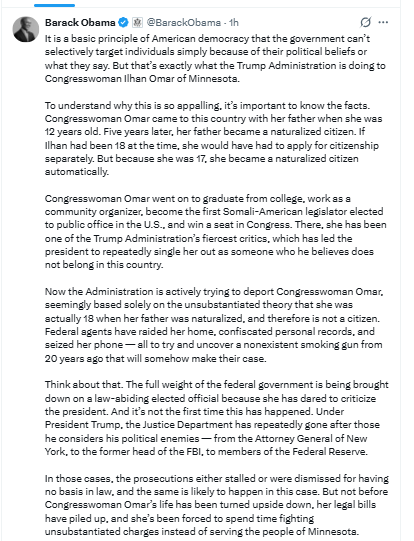
“It is a basic principle of American democracy that the government can’t selectively target individuals simply because of their political beliefs or what they say,” Obama said. “But that’s exactly what the Trump Administration is doing to Congresswoman Ilhan Omar of Minnesota.”
The former president’s remarks place Omar’s case at the centre of a broader debate over presidential power, the independence of federal law enforcement and the protection of political dissent in the United States.
Obama challenges allegations against Ilhan Omar
According to Obama’s statement, the administration is attempting to deport Omar based on an unsubstantiated theory that she was 18 when her father became a naturalised American citizen, rather than 17, as Obama maintains.
He explained that Omar arrived in the United States with her father when she was 12 and that her father became a naturalized citizen five years later. Obama argued that her age at the time meant she automatically acquired citizenship through her father.
“If Ilhan had been 18 at the time, she would have had to apply for citizenship separately. But because she was 17, she became a naturalized citizen automatically,” he said.
Obama further highlighted Omar’s political journey, from graduating from college and working as a community organiser to becoming the first Somali-American elected to public office in the United States and subsequently winning a seat in Congress.
He suggested that her outspoken opposition to Trump had made her a target of the administration.
The specific allegations surrounding Omar’s citizenship, the reported federal actions and the legal basis for any deportation effort require independent verification. Obama’s statement presents his account of the dispute and should not, on its own, be treated as a judicial finding.
Former president warns against weaponising federal power
Obama alleged that federal agents had raided Omar’s home, confiscated personal records and seized her phone while investigating questions about events dating back approximately two decades.
He questioned the proportionality and purpose of the reported actions, arguing that the federal government was directing its resources against an elected official without substantiated evidence of wrongdoing.
“Think about that. The full weight of the federal government is being brought down on a law-abiding elected official because she has dared to criticize the president,” Obama said.
He also placed the controversy within what he described as a wider pattern of investigations involving individuals perceived as political opponents of Trump, citing the New York attorney general, a former FBI director and members of the Federal Reserve.
Obama argued that previous cases had stalled or been dismissed for lacking a legal basis. However, those comparisons and their relevance to Omar’s circumstances would need to be assessed against the individual facts and outcomes of each case.
The broader concern raised by Obama is whether federal investigative and prosecutorial powers can be exercised independently of political pressure, particularly when prominent opposition figures are involved.
Ilhan Omar case raises questions about American democracy
Omar, a Somali-American Democrat representing Minnesota, has become a prominent voice in progressive politics and a frequent critic of Trump’s policies. Her background and political positions have also made her a recurring target of partisan attacks.
The dispute illustrates how immigration, citizenship and national identity can become politically charged issues in an increasingly polarised America.
At the same time, allegations involving citizenship status must be evaluated through documentary evidence and applicable law, rather than political rhetoric alone. Any government action challenging a person’s citizenship must be subject to the relevant legal procedures and judicial scrutiny.
Obama’s intervention adds weight to the political debate because of his status as a former president, although his public criticism does not itself determine the legal merits of the allegations.
Obama warns of dangerous precedent
The former president said the consequences of politically motivated investigations would extend beyond Omar, regardless of whether Americans agree with her views.
“The fact that any president, or any administration, is willing to engage in such transparent efforts to intimidate someone should outrage all Americans, regardless of how they feel about Congresswoman Omar’s political views,” he said.
Obama warned that tolerating such conduct could establish a precedent that future presidents, from either political party, might use against their opponents.
“Because if this becomes the new normal, there’s no reason to believe it will stop with her,” he added.
His central argument is that democratic institutions depend on the principle that political disagreement must not become grounds for selective government punishment.
Whether the allegations against Omar withstand legal scrutiny remains a matter for evidence and due process. But Obama’s warning highlights a fundamental question facing American democracy: how to ensure that the powers of government serve the law rather than the political interests of those who hold office.