Kenya’s fight against Ebola has raised a difficult question over control of emergency health infrastructure: why would the country need to coordinate with Washington before accessing a specialised bio-isolation facility located on Kenyan soil?
The question follows concerns surrounding the US-backed Ebola bio-isolation facility in Laikipia, established to strengthen regional preparedness against deadly disease outbreaks.
The centre, located about 270 kilometres from Nairobi, was designed to provide specialised isolation and treatment capacity during health emergencies. However, uncertainty remains over the terms governing its use and whether Kenya can independently activate it when faced with a worsening outbreak.
The issue has gained attention after the United States confirmed that Kenya had not requested the facility for the Ebola patient who died in Nairobi and that no patients were currently being treated there.
A US State Department spokesman said the Laikipia bio-isolation facility was part of Washington’s broader response to prevent the spread of Ebola and reduce health risks across the region.
“The bio-isolation facility in Laikipia is part of the US government’s holistic response to prevent the spread of the disease and lessen health risks for the region as a whole,” the spokesman said.
However, the statement did not explain whether Kenya requires approval from Washington before using the centre or whether access is governed through an existing agreement between the two countries.
That unanswered question has created debate over Kenya’s control of critical emergency infrastructure at a time when the country is responding to its first imported Ebola case and first confirmed death.
Duale insists Kenya has capacity to contain Ebola
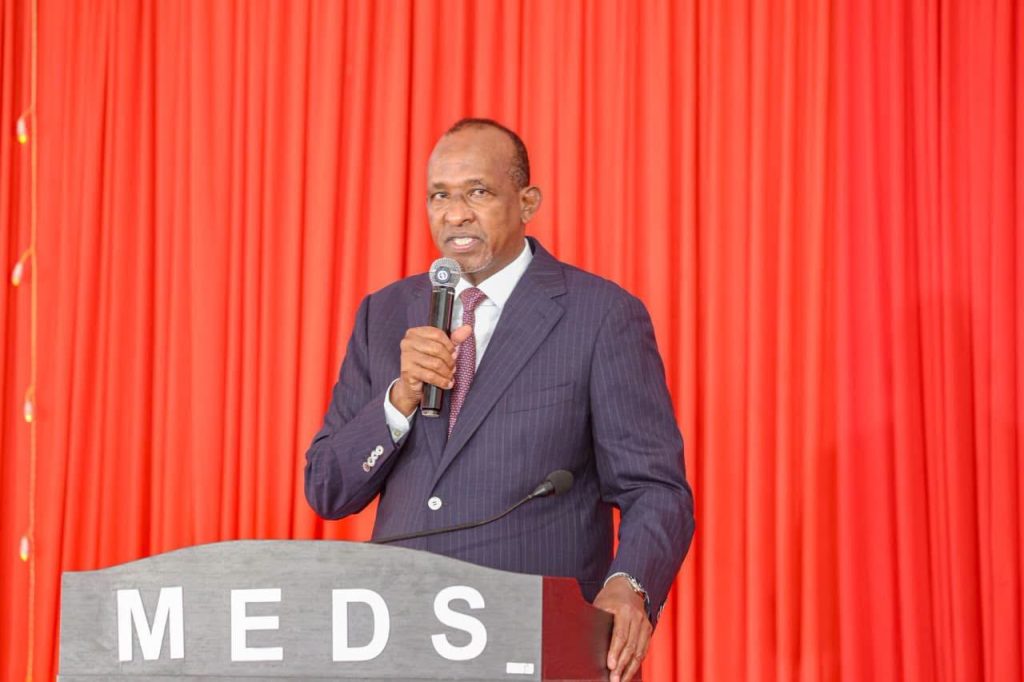
Health Cabinet Secretary Aden Duale has sought to reassure Kenyans that the country has enough capacity to manage the current situation.
Speaking during a tour of the isolation facility at Nairobi Hospital, Duale said Kenya was dealing with an imported Ebola incident rather than an outbreak.
“I will emphasise that there is no Ebola outbreak in Kenya. What we have is an imported Ebola incident in Kenya, and we can account for the pathway journey of that patient from Buri to Kisangani to Beni, to Kinshasa to Kampala to Nairobi, and finally to Nairobi Hospital,” Duale said.
The facilities include Kenyatta National Hospital, Moi Teaching and Referral Hospital, the National Police Hospital, Port Reitz Hospital and Nairobi Hospital.
Duale said Nairobi Hospital had a 133-bed isolation facility, including about 45 high-dependency and intensive-care beds.
He added that Kenya had additional temporary isolation centres at border points, including Malaba Health Centre, Busia Border and Kocholia, while Alupe Sub District Hospital was undergoing renovations.

Kenya’s Ebola response enters a critical stage
The Ministry of Health said Kenya had identified 122 contacts linked to the confirmed Ebola case, with 108 already under quarantine and daily monitoring.
No new case had been recorded, while 293 samples from 289 alerts had been tested, with only the confirmed patient returning positive.
The government has also screened 667,675 travellers at 26 points of entry as part of measures to detect possible infections.
Despite the reassurance, the Laikipia facility question highlights a wider issue about emergency preparedness: whether countries can immediately access internationally supported resources when a crisis develops.
For Ebola, speed is critical. Isolation, specialised treatment and infection prevention measures must be activated quickly to protect health workers and communities.
As Kenya continues tracing contacts and strengthening surveillance, clarity over the operation of the Laikipia facility remains important.
The central question remains: if Kenya’s Ebola situation worsened, would the country be able to immediately use every available facility, or would it first need approval from Washington?