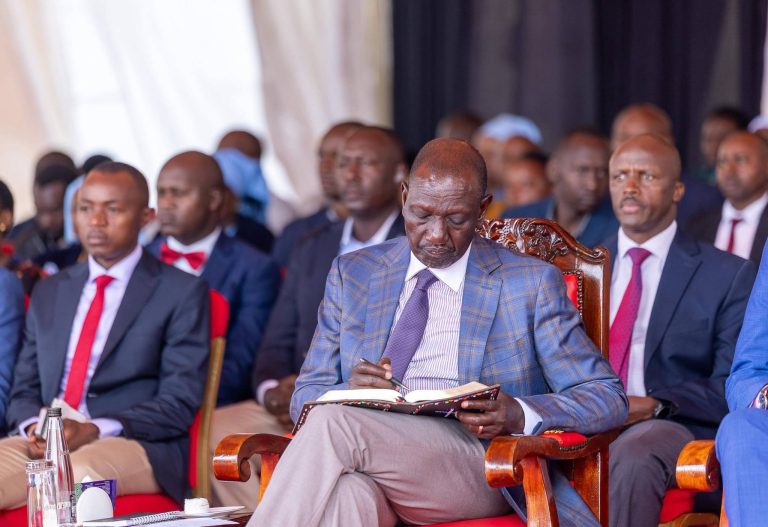
Former Attorney General Justin Muturi has asked the Independent Electoral and Boundaries Commission (IEBC) to summon Interior Cabinet Secretary Kipchumba Murkomen over remarks on identification and voter registration services for Kenyans living in Uganda, putting cross-border registration under fresh political scrutiny ahead of Kenya’s 2027 General Election.
Muturi, the Democratic Party leader, said Murkomen should explain precisely what he meant by remarks made in Uganda that Kenyans without identification documents could obtain them through the Kenyan embassy in Kampala or cross the border to register.
“We therefore demand that the IEBC immediately summon CS Murkomen to explain precisely what he meant and identify the alleged voter registration activities in Uganda,” Muturi said in a statement on Saturday.
The former Attorney General also called on Ugandan President Yoweri Museveni to clarify whether his government was aware of, or had sanctioned, any activities in Uganda connected to Kenya’s electoral process.
“I also call on President Yoweri Museveni to clarify whether his government is aware of, or has sanctioned, any activities in Uganda connected to Kenya’s electoral process,” Muturi said.
Muturi has not provided evidence establishing that Ugandan citizens have been unlawfully registered as Kenyan voters. His demand is for the claims to be clarified and, if credible evidence of wrongdoing emerges, investigated.
“Kenya’s sovereignty is not negotiable, and our elections cannot be compromised,” Muturi said. “Claims of this magnitude demand evidence, transparency, and accountability.”
The intervention comes as Kenya expands voter registration ahead of the August 2027 election, with the IEBC expecting the electoral register to grow to about 28.5 million voters.
What Murkomen said
Murkomen made the remarks during a public engagement in Uganda on Friday, September 25, where he addressed the position of Kenyans living across the border who lack Kenyan identity documents.
He said Kenyans living in Uganda could use the Kenyan embassy in Kampala to obtain documentation.
“I want to assure Kenyans who are here looking for their documents, we have made it easy for you to get your documents, just go to the Embassy in Kampala and get registered. But you can also cross the border and get registered easily,” Murkomen said, according to reports of the remarks.
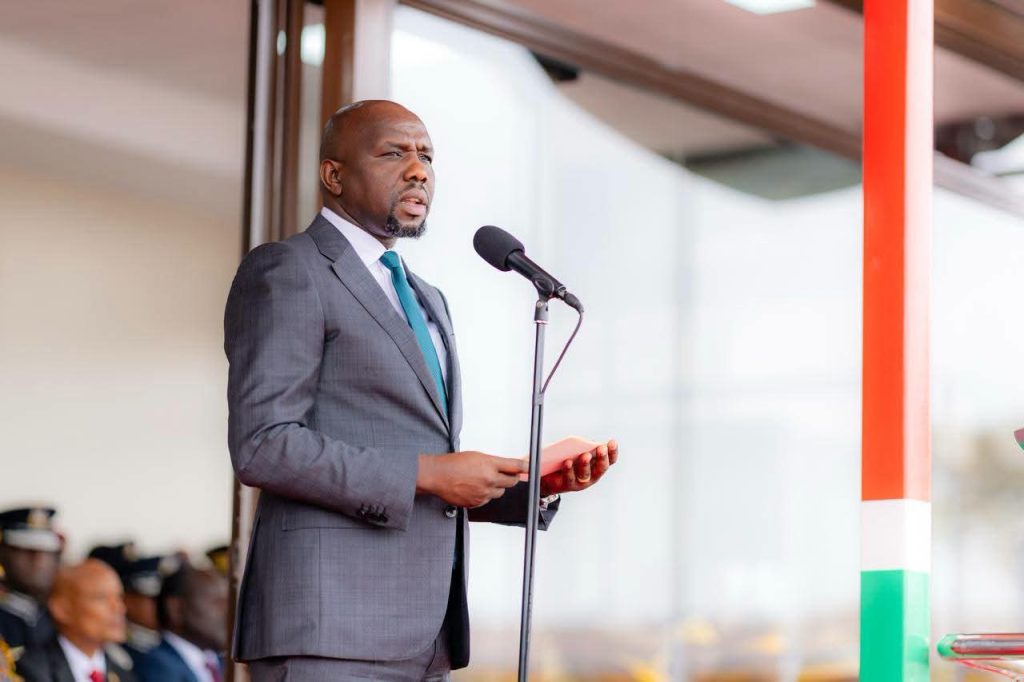
Murkomen also said Kenya would not discriminate against its citizens living in border areas.
“I want to assure Kenyans and East Africans who live on the border, on the Uganda border, in Tanzania border, in the border to Ethiopia, in the border to Somalia, we have said that we will not discriminate against any Kenyan, they have a right to get their IDs, they have a right to get their documentation,” he said.
He also invoked the East African Community’s free-movement principle, saying citizens of the two countries could legally cross borders to pursue work opportunities.
“You can go to Kenya and work in Kenya if you get an opportunity, and people from Kenya can come and work in Uganda when they get an opportunity,” Murkomen said.
The key question raised by the controversy is whether Murkomen was referring to access to Kenyan identity documents for Kenyan citizens living abroad, voter registration, or both, and what procedures apply when such citizens seek to join Kenya’s electoral register.
Neither Muturi’s statement nor the reports of Murkomen’s remarks establish that foreign nationals have been unlawfully registered as Kenyan voters.

Border ID policy
The dispute comes against the backdrop of a major change in Kenya’s approach to identification in border counties.
In February 2025, President William Ruto ended additional vetting requirements for national ID registration in border counties, saying the previous system had subjected residents of Northern Kenya to discrimination and unnecessary scrutiny.
“If it’s about vetting, let all children of Kenya be vetted equally without any discrimination,” Ruto said when he announced the change in Wajir.
The government said the move would make it easier for legitimate residents of Northern Kenya to obtain identification documents and end what it described as years of discrimination and ethnic profiling.
Ruto said the aim was to ensure residents of the region were treated equally with Kenyans elsewhere.
“Let all children of Kenya be subjected to the same vetting for these documents. There are no reasons to continue subjecting others to unnecessary extra-vetting and ethnic profiling,” he said.
The policy creates an important backdrop to the current dispute.
Greater access to identification can reduce exclusion among legitimate Kenyan citizens in border communities. But it also makes the integrity of the standard registration and verification process more important, particularly where identity records eventually interact with electoral registration.
There is currently no evidence establishing that the removal of additional vetting has produced widespread fraudulent voter registration.
Why IEBC matters
The controversy is unfolding while the IEBC is undertaking a large voter-registration exercise.
The commission reported nearly 2.94 million new voter registrations by August 20, 2026, and projected a national register of roughly 28.5 million voters ahead of the 2027 election.
Its election operations plan schedules a second enhanced continuous voter registration exercise from late October 2026 into January 2027, followed by a voter-verification exercise in March and April 2027. The commission plans to generate the register for certification in June 2027.
That timetable gives the controversy practical significance.
Questions about who qualifies to be registered as a Kenyan voter can be addressed through documentation, verification and audit procedures before the register is certified, rather than becoming unresolved political disputes during the campaign.
The issue is also larger than the Uganda border.
Kenya shares extensive communities and economic links with Uganda, Tanzania, Ethiopia and Somalia, and people living around those borders frequently move across jurisdictions for family, work and trade.
The challenge for state institutions is therefore to distinguish between legitimate cross-border movement by Kenyan citizens and eligibility to exercise Kenyan electoral rights.
The 2027 test
Muturi’s intervention is part of a broader push for greater scrutiny of the electoral system ahead of 2027.
Earlier this month, he joined other opposition figures in demanding an independent audit of the voter register, with the group calling for an audit firm to be procured before November 15 and a clean register to be produced by February 15, 2027.
His latest demand extends that scrutiny into the relationship between Kenya’s identity system, cross-border communities and voter registration.
For the IEBC, the immediate issue is whether Murkomen’s remarks accurately described existing procedures for Kenyans living in Uganda and whether those procedures comply with electoral law.
For the government, the question is whether easier access to identification and registration can be maintained without creating uncertainty over who is legally entitled to vote.
Muturi’s demand does not establish that electoral wrongdoing has occurred. But it puts a specific question to Kenya’s electoral and security institutions: what safeguards are in place when Kenyan citizens living across the border seek identity documents and voter registration, and can those safeguards withstand public scrutiny before the 2027 election?
That question is likely to become more consequential as Kenya moves closer to the vote and the finalisation of the next national voter register.