


Kenya recorded a 194 per cent increase in school arson cases in the year to August 2026, raising fresh concerns about student safety and the growing destruction of learning facilities across the country.
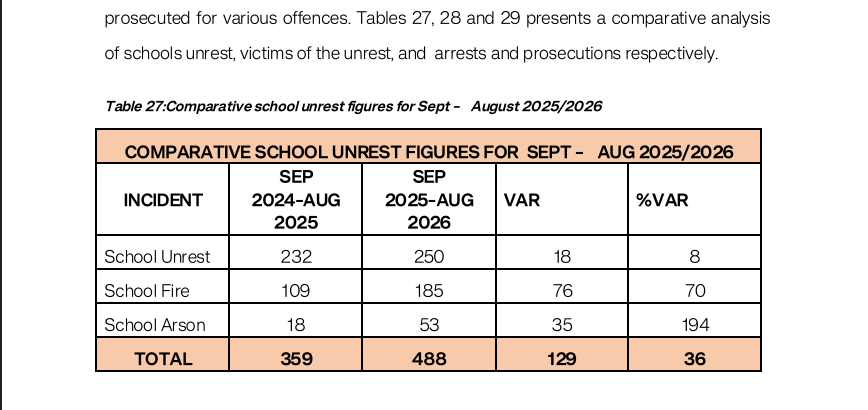
The Annual Report to Parliament on the State of National Security for 2025/2026 shows that arson cases increased from 18 in the previous reporting period to 53 between September 2025 and August 2026.
School fires also increased sharply, rising by 70 per cent from 109 to 185 incidents.
Overall, 488 schools were affected by unrest, fires and arson, compared with 359 in the preceding 12-month period, representing a 36 per cent increase.
The findings highlight a growing security challenge for Kenyan schools, with the government identifying the destruction of dormitories, libraries, administration blocks, stores and classrooms among the consequences of student unrest.
School fires and arson cases rise across Kenya
The report identifies arson as the most prevalent criminal offence associated with unrest in learning institutions during the reporting period.
It warns that the disturbances have increasingly involved criminal activities, including murder, theft and malicious property damage.
“It is evident that most student unrest is premeditated and planned to cause maximum destruction,” the report states.
The number of general student unrest cases increased from 232 to 250, an eight per cent rise.
The government recorded 185 school fire incidents and 53 arson cases during the same period.
The distinction matters because the report lists school fires and arson separately. They should not be treated as mutually exclusive categories or added together as though they represent entirely separate incidents.
Student deaths and injuries raise safety concerns
Beyond damaged buildings and disrupted learning, the report highlights the human cost of insecurity in schools.
Its narrative section records 17 student deaths and 171 people injured, including 145 students and 26 non-students.
However, there is an important discrepancy in the document.
The regional breakdown table records 18 student fatalities and 177 injuries, comprising 145 students and 32 non-students.
The report therefore contains conflicting totals that require clarification from the relevant authorities before the final death and injury figures can be established.
The regional table identifies Rift Valley as the most affected region in terms of student casualties, recording 17 student fatalities and 87 injured students. Nyanza recorded one student fatality and 24 injured students.
The figures underline the seriousness of school safety concerns, although the regional breakdown should be interpreted alongside the report’s inconsistent national totals.
Why are Kenyan students setting schools ablaze?
The government identifies several factors associated with student unrest, including leadership challenges in schools, examination-related anxiety, poor boarding conditions, alcohol and drug abuse, strenuous school routines and peer influence.
Demands by some learners for the early closure of schools are also listed among the contributing factors.
The report further identifies limited structured engagement between school management and students as a challenge in preventing disturbances.
Other concerns include inadequate student mentorship programmes, failure by some school managers to comply with the Safety Standards Manual for Schools, and social media and societal influences encouraging rowdy behaviour.
These findings raise questions about whether existing school management and student welfare systems are adequately addressing grievances before they escalate into violence.
What is the government doing about school unrest?
The government says it has established a multi-stakeholder team to investigate the causes of school disturbances and recommend lasting solutions.
It has also undertaken targeted safety and risk audits of learning institutions to assess compliance with existing safety guidelines.
Other interventions include arresting and prosecuting offenders, establishing information-sharing forums and strengthening collaboration among stakeholders.
The government has also committed to taking administrative and legal action against school management, combating drug and substance abuse in learning institutions and enforcing the Safety Standards Manual for Schools.
It plans to promote positive parenting through structured engagement between parents and other stakeholders.
The unanswered questions about school safety
The sharp increase in school arson raises questions about the effectiveness of existing prevention measures and whether schools are adequately equipped to manage student grievances and emergencies.
The report identifies several underlying challenges but does not provide a detailed breakdown of the individual schools affected, the circumstances behind each fire or the specific causes of the increase in arson.
For parents, teachers and school administrators, the central concern is how to prevent further destruction and protect learners.
With arson cases increasing by 194 per cent in just one reporting period, Kenya faces a pressing question: what is making its learning institutions increasingly vulnerable to fires and violent unrest?