
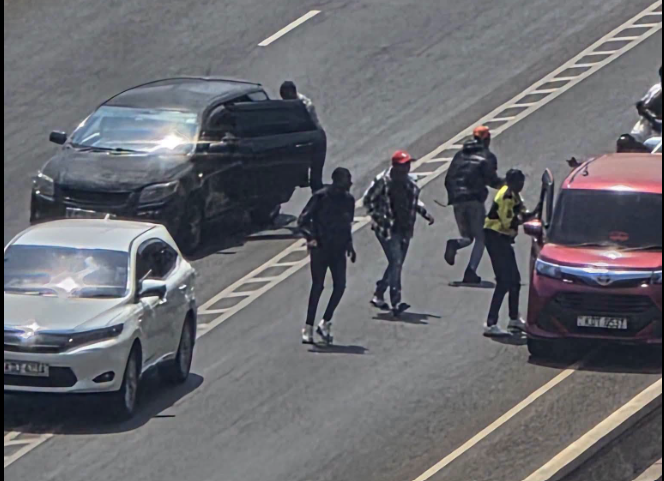
Kenya recorded a sharp increase in active shooter incidents over the past year, raising fresh questions about the country’s changing security threat even as the overall number of people killed, injured or kidnapped in terror-related attacks declined.
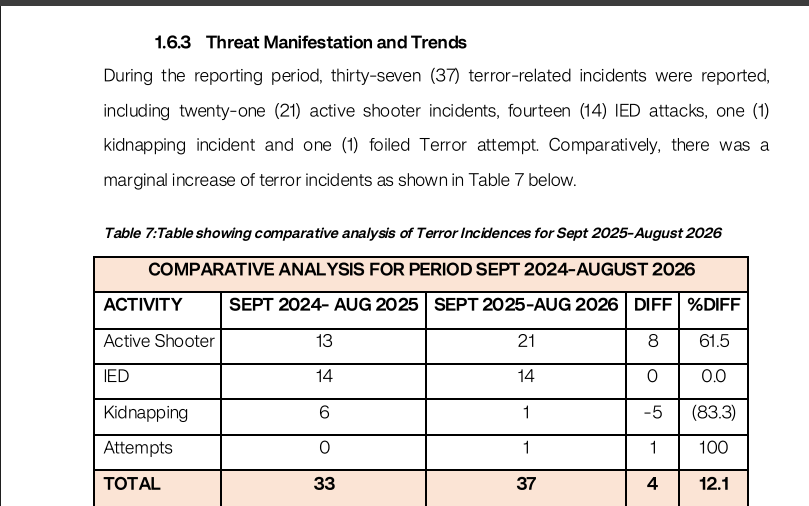
The 2026 Annual Report to Parliament on the State of National Security shows that active shooter incidents increased from 13 between September 2024 and August 2025 to 21 in the following 12 months, representing a 61.5 per cent rise.
The increase made shootings the largest category of reported terror-related incidents during the latest reporting period, accounting for 21 of the 37 cases recorded across the country.
Overall, Kenya recorded 37 terror-related incidents between September 2025 and August 2026, compared with 33 in the previous period, a 12.1 per cent increase.
The figures present a complicated picture for President William Ruto’s administration. While the number of incidents increased, the human cost declined, suggesting that the frequency of attacks and their impact did not move in the same direction.
The government recorded 18 deaths, 34 injuries and five kidnapping victims, bringing the total number of victims to 57, down from 93 in the previous year.
Deaths declined by 25 per cent, while injuries fell by 46 per cent.
However, the rise in shootings points to an important shift in the pattern of reported attacks that security agencies must explain and address.
Shootings now account for the largest share of incidents
The government’s figures show that active shooter incidents increased by eight cases, from 13 to 21, while improvised explosive device attacks remained unchanged at 14.
Kidnapping incidents fell from six to one, while one foiled terrorist attempt was recorded during the latest period, compared with none previously.
This means shootings accounted for more than half of the 37 incidents reported between September 2025 and August 2026.
However, the report does not provide a detailed breakdown of where the 21 shootings occurred, the weapons used, the perpetrators or the number of casualties specifically associated with these incidents.
It also does not explain whether the increase reflects more attacks against civilians, security personnel or infrastructure.
That information is important because the term active shooter alone does not establish the circumstances or motive behind every incident.
The figures nevertheless place shootings at the centre of Kenya’s latest terrorism assessment and raise questions about the operational methods being used by extremist networks.
Al-Shabaab remains the principal threat
Despite the changing pattern of reported incidents, the government continues to identify Al-Shabaab as Kenya’s principal terrorist threat.
The report identifies Mandera, Garissa, Wajir and Lamu as counties facing heightened risks because of their proximity to Somalia. Nairobi and Mombasa are also identified as major urban centres of security concern.
It says Al-Shabaab continues to exploit cross-border vulnerabilities, local facilitation networks, extremist propaganda and socio-economic grievances to sustain its activities.
During the reporting period, the group maintained attacks against security establishments, telecommunication infrastructure and security vehicles along major supply routes, particularly in Fafi sub-county in Garissa and Lamu East.
The government also reported intensified recruitment targeting young people in parts of the Coast and within Dadaab Refugee Complex.
But the threat is not confined to these traditional high-risk areas.
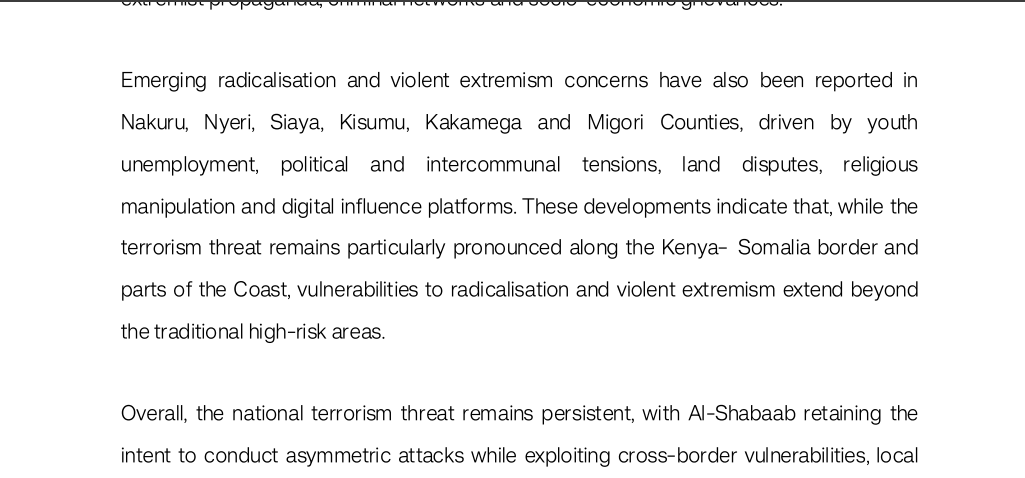
The security assessment identifies Nakuru, Nyeri, Siaya, Kisumu, Kakamega and Migori as counties experiencing emerging radicalisation and violent extremism concerns.
It attributes these vulnerabilities to youth unemployment, political and intercommunal tensions, land disputes, religious manipulation and digital influence platforms.
The report does not identify these six counties as locations where the 21 active shooter incidents occurred. Rather, their inclusion signals a wider prevention challenge as the government confronts vulnerabilities beyond the Kenya-Somalia border and Coast regions.
Prevention remains a challenge
The emerging concerns come as the government implements the National Strategy to Prevent and Counter Violent Extremism 2025–2030, which seeks to strengthen community resilience and coordination between national and county institutions.
National Counter-Terrorism Centre Chief Liaison Officer for Prevention and Reconciliation Joseph Kanyiri has said the strategy had been rolled out in 19 counties, with plans to extend it to all 47.
“It’s not a document that will remain at the national level gathering dust,” Kanyiri said.
However, an October 2026 National Crime Research Centre study found weaknesses in the implementation of county prevention programmes.
The research examined 11 counties, including Nakuru, Nyeri and Kisumu, and found that although most had developed County Action Plans, implementation remained low because of inadequate funding and weak coordination.
The study also found that few programmes specifically targeted women, despite their vulnerability to recruitment and radicalisation.
The findings raise questions about whether county governments have the resources and institutional capacity to address the emerging vulnerabilities identified in the national security report.
Trust and accountability matter
The government also acknowledges that mistrust between communities and law enforcement agencies undermines counterterrorism efforts.
This is significant because preventing extremist recruitment depends partly on communities being willing to report suspicious activities and cooperate with security agencies.
CIVICUS, in its 2026 State of Civil Society Report, warns about increasing pressure on civic freedoms and the importance of community participation in holding institutions accountable.
“Even in these hard times, civil society is holding the line and standing up for dignity, justice and hope,” the organisation says.
It further observes that public trust is essential for civil society organisations to mobilise communities and defend their rights.
“Where civil society groups haven’t connected with people, proved the value of their work and developed trust, they can’t count on support when they come under attack,” CIVICUS says.
The CIVICUS Monitor rates Kenya’s civic space at 31 out of 100, classifying it as repressed. Although this is not a measure of counterterrorism performance, it highlights the wider environment in which community engagement and public accountability must operate.
For Ruto’s administration, the latest figures present two challenges. Security agencies must explain the sharp increase in active shooter incidents while county governments strengthen prevention programmes in communities facing emerging radicalisation concerns.
The decline in victims offers some encouragement, but the increase in shootings shows that the security threat remains persistent.
Ultimately, the government’s success will depend not only on preventing attacks but also on understanding why their patterns are changing and whether its security and prevention strategies are keeping pace.