Kenya has released its first 20 Ebola contacts after they completed the mandatory 21-day monitoring period without developing symptoms, marking a milestone in the country’s response to the Bundibugyo virus disease outbreak.
The Ministry of Health said the individuals were assessed and found to be in good health, allowing them to return to their families as surveillance and containment measures continue nationwide.
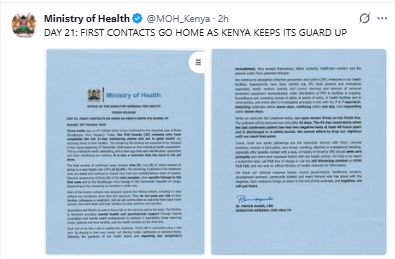
In a press release issued on Monday, October 26, 2026, Director-General for Health Patrick Amoth said the first group’s release demonstrated the importance of early detection, quarantine and close monitoring in containing the outbreak.
“Today, the first twenty (20) contacts who have completed the full 21-day monitoring period and are in good health are returning home to their families,” Amoth said.
The ministry said the remaining 98 contacts are expected to be released in four waves beginning November 3, subject to individual health assessments.
Kenya Ebola outbreak: Nine confirmed cases, two deaths
Kenya confirmed its first imported case of Ebola, identified as Bundibugyo virus disease, on October 6, 2026.
As of October 26, the country had recorded nine confirmed cases, including two deaths, giving the outbreak a reported case fatality rate of 22.2%.
The seven surviving patients remain in treatment units, where they are receiving care from multidisciplinary medical teams.
According to the Ministry of Health, genomic sequencing of three samples linked the infections genetically to the first case and to the Bundibugyo virus lineage in the Democratic Republic of Congo (DRC).
Sequencing of the remaining six samples is ongoing.
The findings provide information about the genetic relationship between the cases, although the ministry has not yet reported the results of the remaining analyses.

98 Ebola contacts remain under monitoring
The ministry said the 20 people released on Monday had met the required criteria, including completing 21 days without symptoms after their last exposure.
Authorities urged communities to welcome those returning home and avoid discrimination or stigma against people who have completed monitoring.
“They do not pose any risk to their families, colleagues or neighbors, and we ask communities to welcome them back home warmly,” the statement said.
The ministry also acknowledged the psychological strain associated with quarantine and illness, saying mental health and psychosocial support is being provided to people in quarantine, discharged contacts, patients, their families and frontline healthcare workers.
Those still under quarantine have been advised to follow instructions from health teams, avoid sharing meals, bathrooms and personal items, and report any symptoms immediately.
Kenya strengthens Ebola surveillance and hospital safety
The Ministry of Health said it was strengthening infection prevention and control measures in health facilities as part of efforts to prevent further transmission.
Measures include facility assessments, the appointment of infection prevention and control focal persons, healthcare worker training and demonstrations on the correct use of personal protective equipment (PPE). Distribution of PPE to health facilities is also ongoing.
Screening and surveillance remain in place at points of entry, health facilities and communities, with suspected cases investigated promptly.
The response follows the World Health Organization’s 7-1-7 approach, which aims to detect outbreaks within seven days, notify authorities within one day and complete initial response actions within seven days.
The ministry said travel, trade and public gatherings have not been restricted.

When will Kenya declare the Ebola outbreak over?
Despite the release of the first 20 contacts, the ministry cautioned that the outbreak is not yet over.
Kenya will only declare the outbreak over after completing a 42-day period calculated from the date the last confirmed patient tests negative twice, with the tests taken at least 48 hours apart, and is discharged or is safely buried.
“While we celebrate this milestone today, our eyes remain firmly on the finish line,” Amoth said, urging Kenyans to maintain vigilance until the required conditions are met.
The 42-day monitoring period is intended to provide time for authorities to detect any further transmission after the final confirmed case has been cleared.
Ebola symptoms: When to seek medical attention
The Ministry of Health has urged anyone experiencing symptoms associated with Ebola, particularly after contact with a suspected or confirmed case or travel history involving the DRC, to seek medical attention promptly.
Symptoms to watch for include fever, unusual tiredness, muscle or joint pain, sore throat, vomiting, diarrhoea and unexplained bleeding.
Anyone seeking care should inform the healthcare worker about any possible exposure to help guide assessment and infection prevention measures.
The ministry has provided two channels for reporting suspected cases or seeking assistance:
- Toll-free hotline: 719
- Jali WhatsApp chatbot: 0700 719 719
Authorities have urged the public to rely on official Ministry of Health communications for verified updates as the response continues.
The ministry thanked national response teams, county governments, healthcare workers, development partners and community leaders for supporting containment efforts, saying continued cooperation will be essential to ending the outbreak.