The first anniversary of Raila Odinga’s death finds the Orange Democratic Movement (ODM) facing a political question that goes beyond commemorating its founding leader: can the party preserve a distinct identity as it moves closer to President William Ruto’s administration and negotiates its place in the 2027 election?
ODM has planned a month-long programme of activities across the country, culminating in the October 15 anniversary in Bondo. The events are intended to celebrate Raila’s political legacy, but they are unfolding against an increasingly visible struggle over what that legacy means for the party he led for years.
The disagreement is no longer confined to policy or personalities. It has developed into a contest over ODM’s political direction, with the Oburu Oginga-led party establishment advancing cooperation with Ruto while a rival camp argues that ODM should retain an independent opposition identity.
That contest has placed the party’s anniversary at the centre of a much larger political transition.
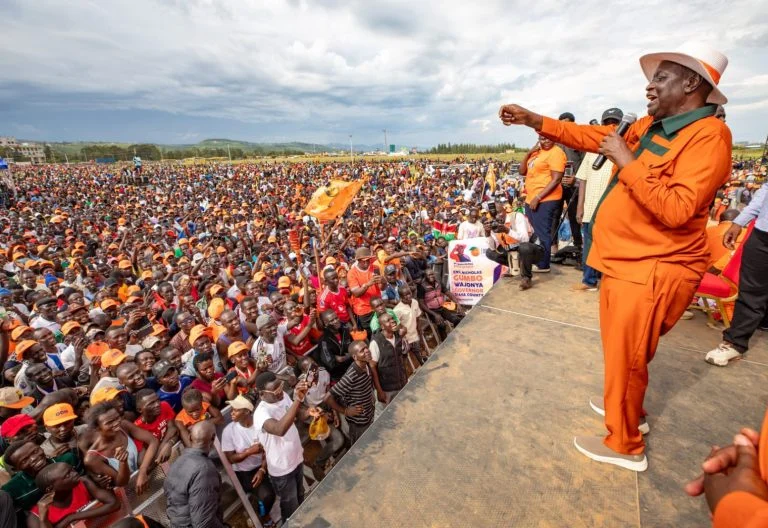
A party in transition
Raila’s death in October 2025 removed the figure who had provided ODM with its strongest political identity and national organising centre.
Oburu, Raila’s elder brother, was subsequently ratified as party leader. Under his leadership, ODM has moved closer to Ruto’s United Democratic Alliance (UDA), with senior officials openly discussing a political arrangement ahead of the 2027 presidential contest.
ODM has said the partnership reflects an understanding reached during Raila’s lifetime. Ruto has similarly presented the two parties as partners rather than traditional competitors.
“ODM and UDA are not competitors; they are partners in the broad-based government,” Ruto said during a recent tour of Nyanza.
That position, however, has not gone unchallenged within ODM.
The dispute became particularly visible around Nairobi Senator Edwin Sifuna, who opposed the party’s increasingly close cooperation with the government. Sifuna was removed as secretary-general after an internal disciplinary process that generated legal challenges before the Political Parties Disputes Tribunal.
The tribunal initially found procedural shortcomings in the attempt to remove him, before a later ruling upheld his removal after a fresh disciplinary process.
The episode demonstrated that ODM’s post-Raila disagreement is not merely theoretical. It has affected senior leadership, party structures and the political careers of prominent officials.
At the same time, the emergence of the Linda Mwananchi movement has provided an organised platform for politicians opposed to the party’s current direction.
The Ruto fault line
The most consequential disagreement concerns whether ODM should become part of a broader Ruto-led political formation or preserve its traditional opposition identity.
Sifuna, Siaya Governor James Orengo, Kakamega Senator Boni Khalwale and other politicians associated with the Linda Mwananchi camp have pushed a different political line from the Oburu-led establishment. In September, the movement endorsed Sifuna as its presidential candidate.
The significance of that challenge is reflected in public opinion research.
A TIFA survey conducted between June 13 and 22 among 2,048 adults across all 47 counties found that 52 per cent of Kenyans opposed the broad-based government, compared with 30 per cent who supported it. Among ODM supporters, 74 per cent backed the Linda Mwananchi position, while 20 per cent supported the Oburu-led Linda Ground faction.

TIFA also found that only 8 per cent of ODM supporters backed Ruto unconditionally as the party’s preferred presidential option, while another 8 per cent supported him under conditions involving ODM.
The figures do not establish how ODM supporters will vote in 2027. They do, however, illustrate the gap between the party leadership’s political direction and the preferences recorded among its supporters at the time of the survey.
That gap makes the anniversary more politically significant.
ODM can invoke Raila’s democratic legacy, but it must also explain how that legacy fits into an alliance with the administration that Raila spent much of his career challenging.
Zoning tests alliance
The second pressure point is electoral zoning as the UDA-ODM relationship has moved beyond cooperation in government towards discussions about a pre-election arrangement, including a joint manifesto and the allocation of political space in the 2027 contest. But cooperation at the national level has not eliminated competition between the parties at the grassroots level.
The question of who contests where could therefore become the practical test of the alliance.
ODM has strong historical networks in Nyanza and parts of Western Kenya and the Coast, while UDA has been seeking to expand its organisation beyond its traditional bases.
That creates competing interests among politicians.
Party leaders may negotiate a national agreement, but MPs, governors and aspiring candidates must ultimately confront voters in individual constituencies and counties. A national pact that limits competition in some areas could protect existing political networks, while allowing both parties to compete elsewhere could expose ODM candidates to direct challenges from their supposed coalition partners.
This is why zoning is more than a technical coalition issue.
It could determine whether ODM enters 2027 as a recognisable political organisation with protected regional influence or as one component of a larger alliance in which its electoral identity becomes less distinct.
ODM National Assembly Minority Leader Junet Mohamed has already made clear that the party intends to protect its political strength.
“We are telling any party that we are associating with, any party in this country that wants to associate with us, our parliamentary numbers are not negotiable,” Junet said during the zoning debate.
Ruto, however, has indicated that cooperation will not necessarily eliminate competition, describing the relationship as one in which there could be “friendly fire” during the next election.
The differing positions expose the unresolved boundary between partnership and competition.
Polls show fluidity
The polling evidence further complicates ODM’s transition. Infotrak’s June 2026 survey placed ODM’s party identification at 21 per cent, compared with 38 per cent in September 2024. Twenty-nine per cent of respondents said they did not identify with any political party.
Its July survey also found Linda Mwananchi at 24 per cent, compared with 27 per cent for the broad-based government and 20 per cent for the United Alternative Government. Among respondents aged 18 to 26, Linda Mwananchi registered 33 per cent.
The figures should not be treated as a forecast of the 2027 election. They are snapshots of political preference at particular moments and, importantly, show a sizeable pool of voters without firm party identification.
For ODM, however, the figures underline the importance of its organisational transition.
The party still retains substantial regional support, but its national political identity is being contested at precisely the moment when its leadership is negotiating a new relationship with government.

That makes Raila’s anniversary more than a commemorative milestone.
The month-long events allow ODM to mobilise the networks associated with its late leader. But they also expose the unresolved question of who now defines those networks and what political purpose they serve.
The family itself has entered the debate over the anniversary. A statement circulated by Raila’s daughter Winnie and sister Ruth said the anniversary “belongs to neither an individual nor an institution,” reflecting disagreement over how the commemoration should be organised.
For ODM, the deeper test will come after the memorial events.
Raila built a party whose identity was closely tied to his political movement. One year after his death, the party is being forced to establish whether that identity can survive without him, and whether it can remain politically distinct while negotiating a 2027 alliance that may require cooperation with former rivals.
The answer will be shaped not by the anniversary speeches alone, but by how ODM resolves its internal divisions, negotiates electoral zoning and converts Raila’s legacy into an organisational strategy for the post-Raila era.