
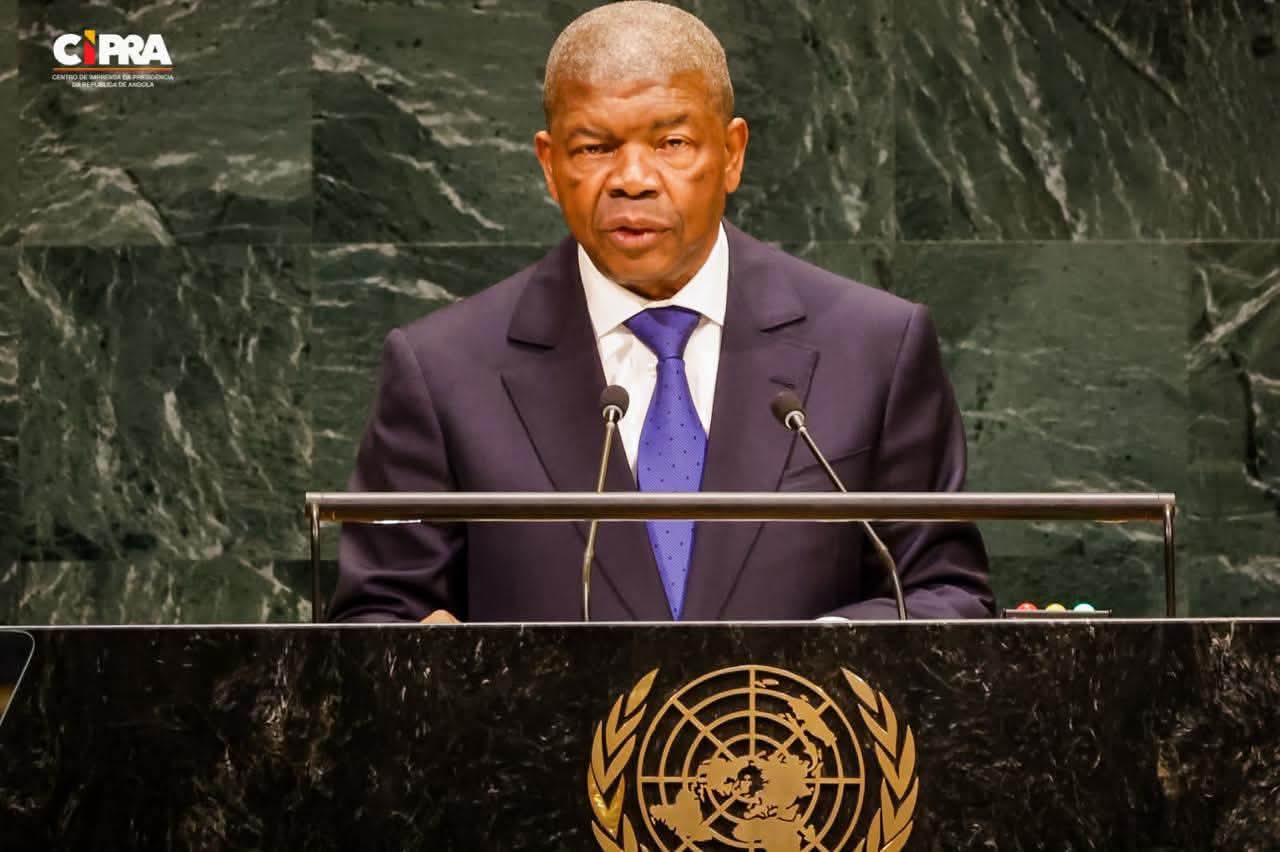
President João LourenAngola’sço has used Angola’s appearance at the United Nations to link the country’s domestic digital transformation drive with a wider African push for greater influence over artificial intelligence governance, arguing that the continent should help shape the rules of an increasingly technology-driven global economy.
Addressing the 81st UN General Assembly in New York on September 22, Lourenço presented artificial intelligence as both a development opportunity and a governance challenge, linking it to education, healthcare, agriculture, scientific research, public services and productivity. He also called for stronger African participation in international discussions on AI governance.
“The digital revolution” should become an instrument of “inclusion, sovereignty and development and not a source of dependence and inequality,” Lourenço said, according to the official transcript of his speech.
The message comes as Angola is attempting to build the digital infrastructure needed to support a more integrated state, with interoperability, digital identity, electronic signatures and cybersecurity becoming central to its reform programme.
Building digital foundations
In June, Angola formalised a $150 million Public Digital Infrastructure Project intended to strengthen interoperability between public systems, digital identity and the security of electronic government services. The project has a planned implementation period of 12 months.
The Institute of Administrative Modernisation said the infrastructure is intended to provide the computing backbone for government interoperability, digital identity and electronic signatures.
“Currently, there are several systems and digital platforms operated by different public services that need to communicate with each other,” said IMA Director-General Meick Afonso. The infrastructure, he added, will allow those systems to “communicate securely, in an integrated and organised manner.”
The project is part of a broader state-reform programme running through 2027, which includes administrative simplification and digital transformation. Angola’s government has described digitalisation as a means of reducing bureaucratic procedures and improving interaction between public institutions, citizens and businesses.
The significance goes beyond putting government services online. Interoperability can allow agencies to exchange information already held within the state, while digital identity and electronic signatures can enable transactions to be completed without physical paperwork.
AI meets States reform
Angola’s AI ambitions are increasingly being connected to that underlying infrastructure.
The country’s Institute of Administrative Modernisation has said it is preparing a national AI strategy for public services, with proposed pillars including technological sovereignty, interoperability, public data and investment in national talent. The institute has also identified connectivity, specialised skills, technological infrastructure, data protection and ethical governance as challenges to AI adoption.
That sequencing reflects a broader African policy debate.
An April 2026 OECD assessment identified infrastructure and computing capacity, data governance, interoperability, skills shortages and institutional coordination among the major challenges confronting AI governance across Africa. It noted that inconsistent data standards and weak interoperability can constrain the reliability and trustworthiness of AI systems.
The International Monetary Fund has similarly said AI could provide significant economic gains in sub-Saharan Africa if countries improve electricity supply, internet connectivity and digital skills, underscoring the importance of infrastructure alongside policy.
For Angola, the domestic digital-state programme therefore provides part of the foundation on which its AI ambitions will depend.
Africa seeks influence
Lourenço’s UN intervention also placed Angola’s digital programme within the continent’s broader debate over technological sovereignty.
His call for African participation in global AI governance comes as African governments and institutions seek greater influence over standards, data, infrastructure and the distribution of economic benefits generated by emerging technologies.
The Institute for Security Studies has warned that Africa’s ambitions for AI sovereignty will remain difficult to sustain without investment in electricity, computing infrastructure, connectivity and data ecosystems.
That concern is echoed by the UN Development Programme, which says African countries are moving from discussions about AI readiness towards questions of implementation, including who controls systems, how they are financed, what safeguards apply and where the resulting value accumulates.
For Angola, the diplomatic argument is consequently tied to a practical domestic question: whether building interoperable government systems, secure digital identity and reliable infrastructure can give the country greater capacity to develop and govern AI applications locally.
Execution becomes test
Angola’s movement into Group B in the World Bank’s 2025 GovTech Maturity Index provides evidence of progress, but the index is explicitly designed as a diagnostic rather than a performance ranking. It measures four areas: core government systems and shared infrastructure, online services, citizen engagement, and institutional enablers such as regulation, skills and innovation policy.
The government’s own timetable points to the remaining work. The $150 million infrastructure project is only beginning implementation, while the wider digital transition programme still involves integrating systems and developing supporting legal and institutional frameworks.
For Lourenço, the UN speech has therefore elevated Angola’s digital transformation from an administrative modernisation issue to part of a wider foreign-policy narrative about Africa’s technological position.
The central test will now be execution: whether the infrastructure being built in Angola can translate into more accessible public services, stronger institutional capacity and a greater domestic role in the development and governance of artificial intelligence.
That will determine whether the country’s digital-state agenda remains primarily a government modernisation programme or becomes part of Angola’s broader effort to establish a voice in Africa’s emerging digital economy and the global debate over AI.