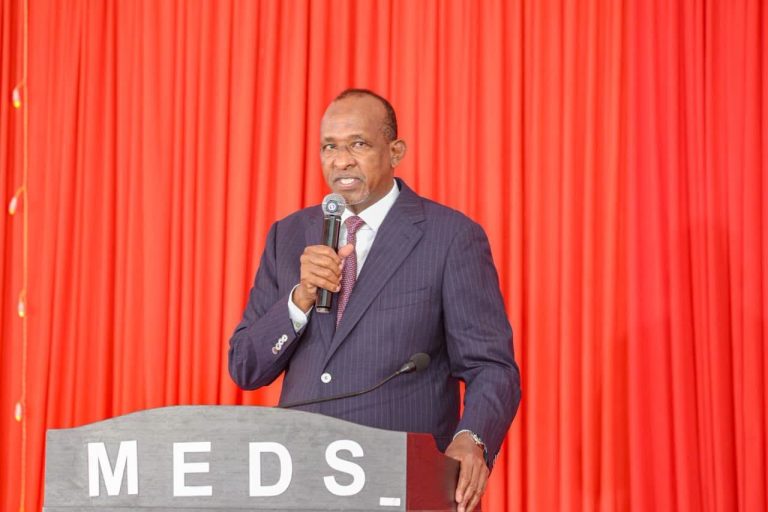

President William Ruto has assured Lamu residents that the government will not displace them from the main site earmarked for the proposed Dangote East Africa Petroleum Refinery, saying the land belongs to the Kenyan government.
Ruto clarified during a media engagement at State House, days after the groundbreaking ceremony for the Ksh2.2 trillion refinery in Mokowe, Lamu County. His remarks come amid a legal dispute involving residents who have raised concerns over land ownership, compensation and possible displacement linked to the project.
The President said the land where the refinery is being developed is government-owned and therefore does not require residents to be removed to create space for the facility.
“Regarding the Lamu site, there are no citizens whom we will be displacing from that location; the land there belongs to the government,” Ruto said.
He added that if residents are found occupying other parcels of land that the government intends to use for the refinery or related infrastructure, the responsibility for compensation would fall on the Kenyan government rather than investor Aliko Dangote.
“And if there are citizens located elsewhere, on land the government intends to utilise for the operation of that plant, it is the Kenyan government that will compensate them, not the investor,” he said.

LAPSSET land compensation
Ruto linked the land question to the wider Lamu Port-South Sudan-Ethiopia Transport (LAPSSET) Corridor and the planned Special Economic Zone around the refinery.
According to the President, the government had previously released Ksh1.3 billion to compensate residents and facilitate land clearance for the LAPSSET Special Economic Zone.
The explanation is significant because residents have been questioning who should compensate communities affected by the expansion of infrastructure around the refinery site.
The land dispute has already reached court. More than 100 residents have challenged the use of land associated with the refinery, arguing that their families have occupied, cultivated and developed parts of the area for generations.
Some residents say they face the loss of homes, farms and other property without adequate compensation or a clear resettlement plan.
The Malindi Environment and Land Court has ordered parties to maintain the status quo on a disputed parcel linked to the refinery as the legal process continues. The matter is scheduled for an inter partes hearing on October 14, 2026.
Ruto defends refinery project
The President’s comments came shortly after he joined Dangote Group President Aliko Dangote and other African leaders for the groundbreaking of the refinery on September 30.
The planned facility is expected to have a processing capacity of 700,000 barrels of crude oil per day and is projected to serve Kenya and other markets across East Africa. Reuters reported that the project is expected to be completed by 2030 and represents a major investment in Kenya’s energy and industrial sectors.
Ruto has also acknowledged that Lamu residents have legitimate questions about the project’s impact on land, employment, businesses, fishing, water resources and the environment. He said such concerns should be addressed as the investment proceeds.
The refinery nevertheless continues to face legal challenges from residents and other stakeholders over land rights and environmental concerns. Dangote has maintained its commitment to the project despite the court dispute, while the legal process over the contested land continues.
For Lamu residents, the government’s position means that any compensation arising from additional government land requirements would be handled by the State. However, questions over specific parcels, occupants’ rights and compensation remain subject to the ongoing legal proceedings.
The government is therefore moving ahead with the refinery while the courts continue to consider claims concerning land ownership, acquisition and compensation in the project area.