
When President William Ruto addressed Kenyans on Mashujaa Day, he presented himself as a leader committed to national progress, constitutionalism and the rule of law.
Yet, as journalists covered protests against rising fuel prices in Nairobi, Citizen TV reporter Francis Ode was roughed up by plainclothes police officers, bundled into a police vehicle and detained.
The contradiction was brutal: a government invoking constitutional values while a journalist documenting public anger found himself at the centre of an alleged police assault.
Ode’s arrest on October 20, 2026, has become another uncomfortable test of Ruto’s administration. The National Police Service has confirmed an internal investigation, while the Independent Policing Oversight Authority (IPOA) has launched an independent inquiry.
But for critics, the question is whether investigations into alleged police misconduct will deliver accountability or become another exercise in official reassurance.
Mashujaa Day hypocrisy
Ode was covering demonstrations along Kimathi Street in Nairobi’s Central Business District when plainclothes officers allegedly arrested him despite his attempts to identify himself as a journalist.
Recounting the ordeal, Ode said he feared for his life while detained at Central Police Station, where teacher and blogger Albert Ojwang died in custody.
“Nilikuwa na hofu sana,” he said, describing his fear as he wondered whether he could suffer the same fate as someone whose death he had reported on.
Ode also recalled a uniformed officer allegedly directing colleagues to arrest him with the words, “Shika huyu pia.”
He said officers ignored his protests that he was working as a journalist, allegedly squeezed him and tore his clothes during the arrest.
The incident raises a fundamental question for Ruto’s government: if journalists cannot safely document public demonstrations, what practical meaning does the constitutional guarantee of media freedom have?
There is no publicly established evidence that Ruto personally ordered Ode’s arrest. Nevertheless, the conduct of officers operating under the state’s authority places the government under pressure to demonstrate that constitutional rights are protected in practice, not merely celebrated in speeches.
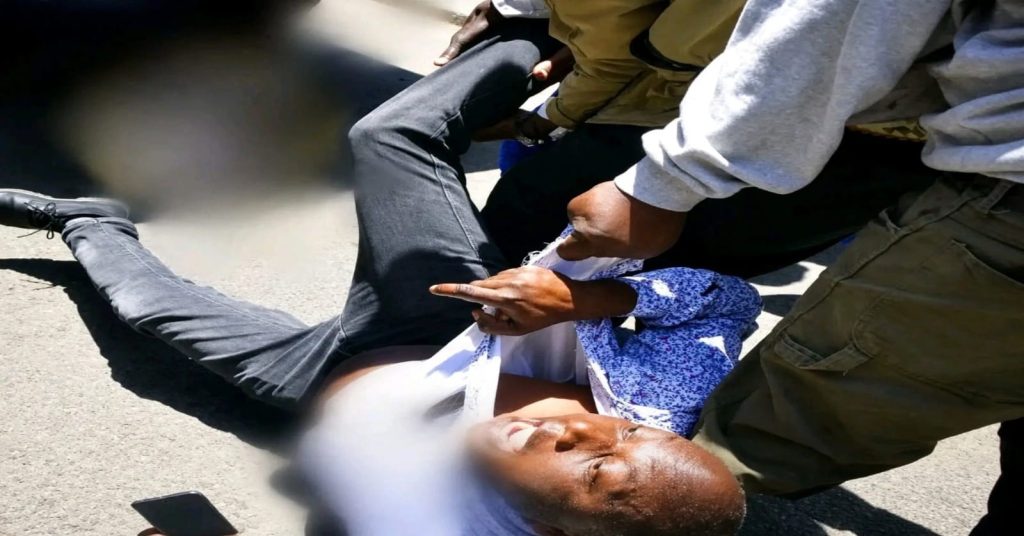
Citizen TV journalist Francis Odee mishandled by police officers while covering a public press conference and peaceful demonstrations over rising fuel prices along Kimathi Street in Nairobi’s Central Business District.
Police promises, public doubts
On October 22, the National Police Service announced that its Internal Affairs Unit had begun investigating the circumstances surrounding Ode’s arrest.
“Upon receipt of the report, the NPS Internal Affairs Unit (IAU) commenced investigations to establish the facts and circumstances surrounding the incident, with a view to taking appropriate, transparent and accountable action within the confines of our laws,” the police said.
The service also pledged: “The NPS will cooperate fully and provide all necessary support to facilitate a thorough, credible and expeditious investigation.”
Those words acknowledge the seriousness of the complaint. But the political damage will not be repaired by carefully worded statements alone.
Ode’s release without charge does not, by itself, establish whether the arrest was lawful or whether individual officers committed misconduct. Those questions require evidence and a credible investigation.
However, where a journalist says his identification was ignored and physical force was used against him, authorities must explain what justified the arrest and whether officers followed established procedures.
IPOA’s credibility test
IPOA has opened an independent investigation and said it would examine police records at Central Police Station and obtain accounts from officers deployed to manage public order during the protests.
The authority said its inquiries would “seek to establish the circumstances of the arrest and detention and determine whether the actions of the officers involved complied with the law and established policing procedures.”
Citizen Digital reported on October 21 that IPOA intended to summon more than seven officers, including Central Police Station OCPD Patrick Gogo and five constables, to explain their roles in the arrest. The authority is also examining Ode’s allegation that his complaint was not properly recorded.
For Kenyans frustrated by repeated allegations of police excesses, IPOA risks being dismissed as a “toothless bulldog” if investigations repeatedly generate headlines without visible accountability. That is a criticism of public confidence in the institution, not proof that its current investigation will fail.
The test is whether IPOA can establish the facts independently, publish credible findings and pursue appropriate action where the evidence supports it.

Kiprotich’s warning
The case also recalls the reported abduction of Standard Group Associate Editor Alex Kiprotich, who was seized by armed men on September 1 and released hours later near Masinga Dam.
The Committee to Protect Journalists called for an independent investigation into the incident and allegations of police involvement.
CPJ Africa programme director Angela Quintal said Kenyan authorities had “failed spectacularly in their duty to protect Alex Kiprotich,” warning that the incident demanded “an immediate, independent, and credible investigation.”
The Kiprotich and Ode cases are distinct; publicly available evidence does not establish that they were coordinated or ordered by the same people. Yet both have intensified scrutiny of the safety of journalists reporting on politically sensitive events.
For Ruto, the challenge is no longer simply defending the government’s rhetoric. It is demonstrating that police officers are accountable under the same law they enforce.
If investigations establish misconduct, credible action must follow. If the allegations are not substantiated, authorities must explain the evidence behind their conclusions.
Kenya’s press freedom will ultimately be measured not by Mashujaa Day speeches or police assurances, but by whether journalists can report on the exercise of power without fearing the institutions meant to protect them.