
Kenya’s household shopping basket moved in sharply different directions in September, with the price of milk, cabbage, wheat flour and potatoes rising while tomatoes, sugar, maize flour, electricity and cooking gas became cheaper, according to new Kenya National Bureau of Statistics (KNBS) data.
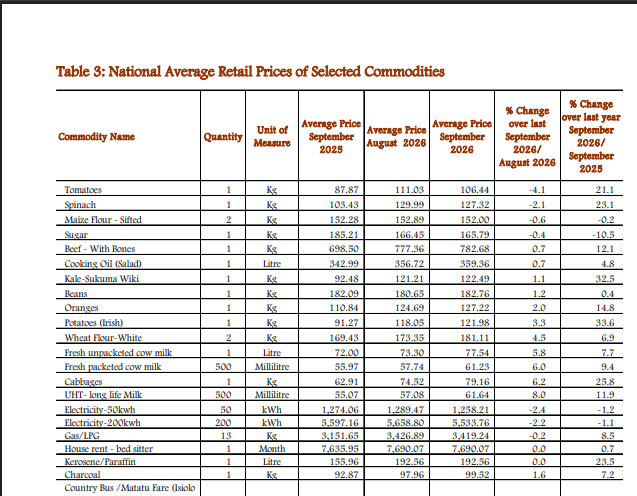
The clearest increase was recorded in 500ml UHT long-life milk, whose average price jumped 8.0 per cent during the month, from Ksh57.08 in August to Ksh61.64 in September.
The increase came alongside a 6.2 per cent rise in cabbage prices, a 6.0 per cent increase in fresh packeted cow milk and a 5.8 per cent rise in fresh unpacketed cow milk.
At the same time, households buying some other common products received modest relief. The average price of a kilogramme of tomatoes fell 4.1 per cent, while sugar declined 0.4 per cent and a 2kg packet of sifted maize flour fell 0.6 per cent.
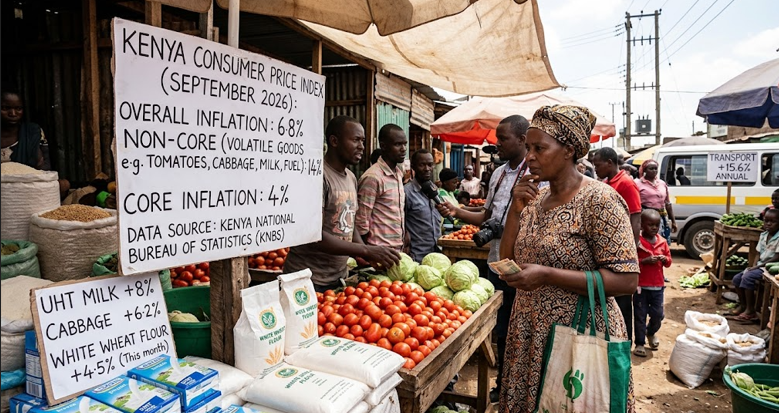
The contrasting price movements came as Kenya’s annual inflation rate stood at 6.8 per cent in September 2026, with consumer prices rising 0.4 per cent between August and September.
KNBS said the overall Consumer Price Index increased from 155.85 in August to 156.47 in September.
Milk leads price increases
Milk emerged as one of the biggest sources of upward pressure in the September household basket.
The average price of 500ml UHT long-life milk rose by 8.0 per cent to Ksh61.64. Fresh packeted cow milk increased by 6.0 per cent, from Ksh57.74 to Ksh61.23 for 500ml, while fresh unpacketed cow milk rose 5.8 per cent to Ksh77.54 per litre.
Cabbage prices increased 6.2 per cent, taking the average price of a kilogramme to Ksh79.16.
A 2kg packet of white wheat flour rose 4.5 per cent, from Ksh173.35 to Ksh181.11, while potatoes increased 3.3 per cent to Ksh121.98 per kilogramme.
Oranges rose 2.0 per cent to Ksh127.22 per kilogramme, while beans increased 1.2 per cent to Ksh182.76.
The average price of a litre of salad cooking oil also edged up 0.7 per cent, from Ksh356.72 to Ksh359.36.
Tomatoes and sugar fall
The September data also recorded declines in several products commonly bought by Kenyan households.
Tomatoes provided one of the largest reductions among the selected food items, with the average price of a kilogramme falling 4.1 per cent, from Ksh111.03 to Ksh106.44.
Spinach prices declined 2.1 per cent, from Ksh129.99 to Ksh127.32 per kilogramme.
The average price of a 2kg packet of sifted maize flour fell 0.6 per cent, from Ksh152.89 to Ksh152.00, while sugar declined 0.4 per cent, from Ksh166.45 to Ksh165.79 per kilogramme.
KNBS noted that price movements across different commodities were mixed during the month.
Energy costs also eased. The average electricity bill for a household consuming 50 kWh declined 2.4 per cent, from Ksh1,289.47 to Ksh1,258.21.
For households consuming 200 kWh, the average electricity cost fell 2.2 per cent, from Ksh5,658.80 to Ksh5,533.76.
The average price of a 13kg LPG cylinder slipped 0.2 per cent, from Ksh3,426.89 to Ksh3,419.24.
Food inflation stays high
The mixed movements in individual food prices came against a broader increase in the cost of food.
KNBS reported that Food and Non-Alcoholic Beverages inflation reached 9.5 per cent in the year to September, well above the overall inflation rate of 6.8 per cent.
Monthly, the food and non-alcoholic beverages division rose 0.9 per cent in September.
The division carries a 32.9 per cent weight in the Consumer Price Index, making it the largest of the 13 major expenditure divisions used by KNBS to measure changes in the cost of living.
This means the fall in the price of individual products such as tomatoes and sugar did not translate into an overall decline in food costs.
The September figures instead show a divided shopping basket: some staples became cheaper while several other frequently purchased foods, particularly milk and vegetables, became more expensive.
Annual increases remain steep
Some commodities that rose in September have also recorded substantial increases compared with a year earlier.
Irish potatoes were 33.6 per cent more expensive than in September 2025, with the average price increasing from Ksh91.27 to Ksh121.98 per kilogramme.
Cabbage prices were up 25.8 per cent year-on-year, while spinach increased 23.1 per cent and tomatoes rose 21.1 per cent.
Milk prices also remained significantly higher than a year earlier. UHT long-life milk increased 11.9 per cent, while fresh packeted cow milk rose 9.4 per cent year-on-year.
Sugar moved in the opposite direction. Its average price was 10.5 per cent lower than in September 2025, falling from Ksh185.21 to Ksh165.79 per kilogramme.
The figures highlight why Kenya’s headline inflation rate does not capture the experience of every household equally. The actual change in a family’s monthly spending depends on which goods it buys and how frequently it buys them.
For a household purchasing milk, cabbage, potatoes and wheat flour, September brought several notable price increases. For consumers buying tomatoes, sugar, maize flour and electricity, some costs moved in the opposite direction.
KNBS compiles the Consumer Price Index through monthly retail-price surveys covering a statistically representative sample of outlets in urban areas across 50 data-collection zones nationwide, with prices collected during the second and third weeks of eac


