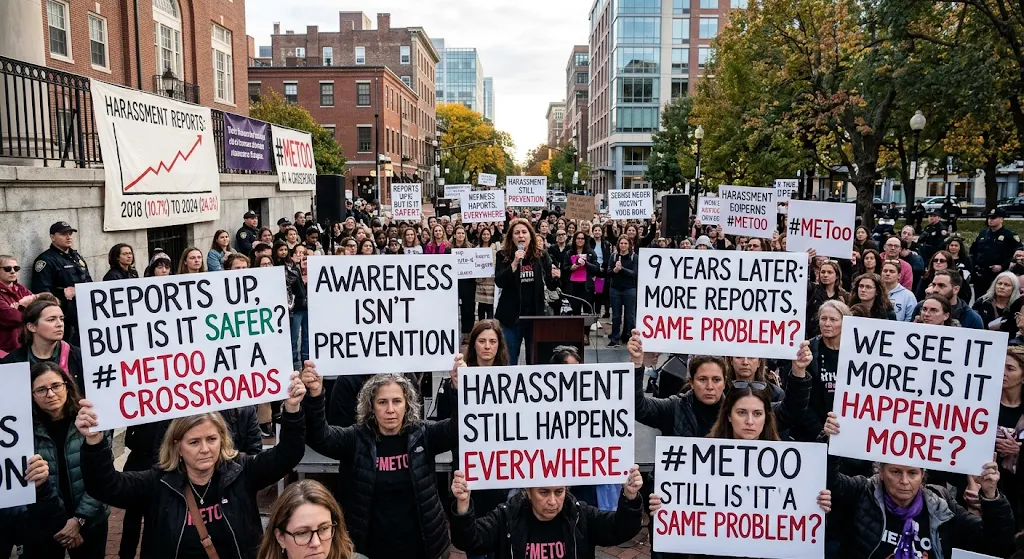
Nearly a decade after the #MeToo movement sparked a global reckoning over sexual harassment, new research suggests the problem remains deeply entrenched in American society, despite years of heightened awareness and efforts to strengthen protections.
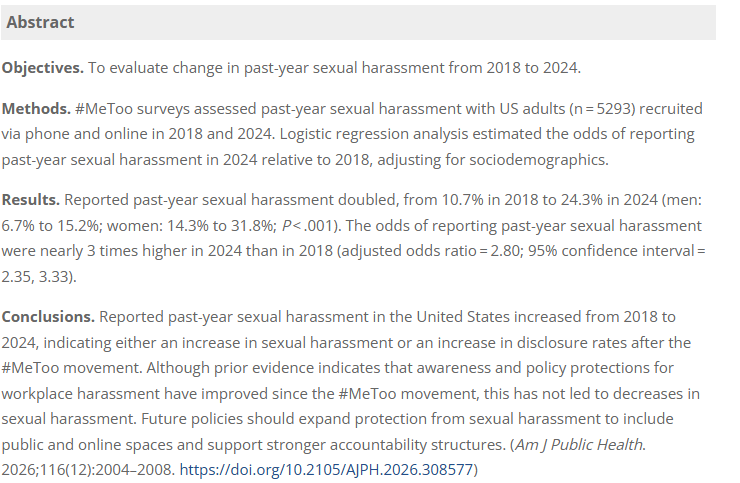
The proportion of US adults reporting sexual harassment in the previous year more than doubled between 2018 and 2024, rising from 10.7 per cent to 24.3 per cent, according to a study published in the American Journal of Public Health.
The findings raise a difficult question for policymakers and institutions that have spent years confronting sexual misconduct: has the drive to change attitudes and strengthen protections made people safer, or simply made more people willing to speak about their experiences?
Researchers from Tulane University’s Newcomb Institute analysed data from 5,293 US adults who participated in the 2018 and 2024 #MeToo national surveys.
The increase was recorded among both women and men, although women continued to report substantially higher levels of harassment.
Among women, the proportion reporting sexual harassment in the previous year rose from 14.3 per cent in 2018 to 31.8 per cent in 2024. Among men, it increased from 6.7 per cent to 15.2 per cent.
After adjusting for demographic differences, the researchers found that the odds of reporting past-year sexual harassment were 2.8 times higher in 2024 than in 2018.
But the figures do not necessarily mean that the actual number of harassment incidents increased by the same proportion.
Dr Anita Raj, executive director of Tulane University’s Newcomb Institute and senior author of the study, said the research could not establish whether the increase reflected more harassment or greater recognition and disclosure.
“It is unclear if this is a true rise in incidents or improved recognition and disclosure,” she said.
That distinction is central to understanding the findings.
The 2018 survey asked respondents about lifetime experiences of different forms of harassment and when their most recent experience occurred. The 2024 survey used direct questions about experiences during the previous year.
Although researchers used the available responses to estimate past-year experiences in both surveys, differences in how the questions were structured, particularly in measuring online harassment, complicate direct comparisons.
The study therefore identifies a substantial increase in reported experiences, but cannot establish what proportion reflects a genuine rise in incidents and what proportion reflects changing awareness, recognition or willingness to disclose.
The limits of the #MeToo movement
The #MeToo movement gained international momentum in 2017, encouraging survivors to speak publicly about sexual harassment and abuse and exposing how institutions had frequently failed to address misconduct.
Its influence extended into workplaces, politics, entertainment and public policy, placing greater pressure on employers and institutions to establish reporting procedures and hold perpetrators accountable.
Yet the latest research suggests that greater visibility and improved workplace protections have not been accompanied by a decline in reported harassment.
In a statement accompanying the research, Raj said: “What we cannot tell from these data is whether sexual harassment has increased or whether more people now recognize and report these experiences. Either way, the findings show that awareness alone has not solved the problem.”
The distinction is important. Encouraging survivors to disclose harassment is not the same as preventing it, while the existence of policies does not necessarily mean those policies are effective in practice.
The researchers argue that existing protections must extend beyond conventional workplace settings to address harassment in public and online spaces.
Harassment does not stop at the office door
Sexual harassment can take different forms, from unwanted sexual comments and intimidation to inappropriate physical contact and abusive online communications.
The 2024 survey examined experiences across several categories, including verbal harassment, cyber harassment, dating coercion and physically aggressive harassment. Sexual assault was also assessed as a separate category.
This broader understanding of harassment highlights a limitation of policies that concentrate primarily on workplace conduct.
People can experience harassment while commuting, using social media, interacting with strangers or navigating personal relationships. In these settings, the responsibility for preventing misconduct cannot rest solely on employers.
Online spaces present additional challenges, particularly when unwanted sexual communications, threats and the sharing of intimate images occur outside traditional institutional boundaries.
The researchers argue that protections must reflect these realities, with stronger accountability structures and more equitable safeguards.
What the numbers cannot tell us
The findings should also be considered in the context of the research design.
The study compared survey data collected in 2018 and 2024 rather than following the same individuals over six years. Its results therefore show differences between population-level survey estimates, not the experiences of a single group of people tracked over time.
Self-reported experiences can also be influenced by how questions are worded, respondents’ understanding of harassment and their willingness to disclose sensitive experiences.
These limitations do not invalidate the findings, but they make it difficult to attribute the increase to any single cause.
Nor does the study establish that the #MeToo movement or subsequent policy reforms caused harassment to increase.
Instead, it identifies a troubling gap between the greater attention paid to sexual harassment and the continued prevalence of reported experiences.
Beyond awareness
For policymakers, employers and public institutions, the challenge is to move beyond awareness campaigns towards prevention, meaningful accountability and protections that cover the places where harassment actually occurs.
The researchers call for stronger safeguards in public and online environments, more equitable protections and continued national monitoring to establish how patterns of harassment change over time.
That monitoring is particularly important because without consistent measurement, it becomes difficult to determine whether interventions are reducing harassment or whether changes in reporting are obscuring the underlying picture.
The latest figures do not offer a definitive verdict on the success or failure of the #MeToo movement.
They do, however, reveal that the problem remains far from resolved.
Nearly a decade after millions of people helped change the conversation about sexual harassment, the question is whether greater recognition can finally translate into fewer people experiencing it.