

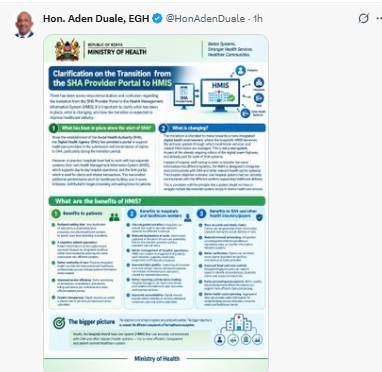
Health Cabinet Secretary Aden Duale has clarified Kenya’s transition from the Social Health Authority (SHA) Provider Portal to hospital-based Health Management Information Systems (HMIS), saying the move is intended to eliminate duplicate data entry, streamline claims processing and create a more integrated digital healthcare system.
Duale, through the Ministry of Health, said the transition has generated confusion because hospitals have been using two separate digital platforms since the establishment of SHA.
The ministry explained that the Digital Health Agency (DHA) initially provided the SHA Provider Portal to enable healthcare providers to submit and transmit claims to SHA, particularly during the transition to the new health financing system.
At the same time, hospitals continued using their own HMIS to manage routine operations, including patient care and administrative functions.
“This has created additional administrative work for healthcare facilities and, in some instances, contributed to longer processing and waiting times for patients,” the ministry said.
The government is now seeking to move towards a system in which the hospital’s HMIS serves as the primary platform for managing healthcare services and related information, while communicating electronically with SHA and other relevant health-sector systems.
What is changing from the SHA Provider Portal to HMIS?
The Ministry of Health said the transition does not amount to the introduction of a completely new hospital system.
“This is not a new system, it’s part of the already ongoing rollout of the digital super highway, and already paid for suite of SHA systems,” the ministry stated.
Under the proposed integrated model, hospital staff would no longer need to enter or transfer the same patient and service information manually into multiple platforms.
Instead, information captured through the hospital’s HMIS would be designed to flow to SHA and other connected systems where required.

The ministry said the objective is to have one hospital system capable of securely communicating with the different systems supporting healthcare delivery.
“The broader objective is simple: one hospital system that can securely communicate with the different systems supporting healthcare delivery,” it said.
What does the HMIS transition mean for patients?
For patients, the government says the integration is expected to reduce administrative duplication and create a smoother healthcare journey.
The Ministry of Health identified reduced waiting times as one potential benefit, arguing that cutting repetitive data-entry processes could allow healthcare workers to spend more time attending to patients.
The ministry also said an integrated workflow could reduce the need for patients’ information to be repeatedly entered into different systems.
“A smoother patient experience” is among the expected benefits, with patient information captured and accessed through an integrated workflow.
The ministry further said properly integrated health records could support better continuity of care, allowing authorised healthcare professionals to access relevant patient information when needed.
Other potential improvements include faster processing of admissions, consultations, procedures, billing and insurance claims.
These are intended benefits of the integration rather than claims that all hospitals are already experiencing them.

Why hospitals are moving towards an integrated system
The transition is also designed to reduce the administrative burden on hospitals and healthcare workers.
Under the current arrangement described by the ministry, facilities have had to work across their own HMIS and the SHA Provider Portal.
The proposed integrated model would allow information captured at the point of care to flow to relevant systems without repeated manual entry.
The ministry said HMIS can also support management of patients, staff, facilities, supplies, medicines, equipment and financial processes.
Capturing information once and using it across connected systems could also improve data quality by reducing inconsistencies and errors caused by repeated data entry.
Hospital managers could receive more timely information for planning resources and making decisions, while digital records could provide greater visibility of services delivered, resources used and claims submitted.
How the change could affect SHA claims
One of the most significant aspects of the transition concerns the processing of healthcare claims.
The Ministry of Health said integration could allow claims to be generated from information captured during the actual delivery of healthcare services.
According to the ministry, this could result in more accurate and timely claims while reducing the need for healthcare providers to repeatedly enter or transfer information.
The system could also strengthen verification by linking claims more closely to patient encounters and the services actually provided.
The ministry said integrated digital records could make it easier to identify “inconsistencies, duplicate claims and unusual transactions,” potentially improving controls against fraud and errors.
Better-quality electronic information could also support more efficient claims processing and payment.
HMIS and SHA: the bigger digital health picture
Duale’s clarification frames the transition as part of a wider digital-health integration programme rather than simply the replacement of one claims portal with another.
“The bigger picture is simply to connect the different components of the healthcare ecosystem,” the ministry said.
The intended model would see hospitals operate an HMIS that can securely communicate with SHA and other relevant health systems.
This would connect different parts of the healthcare ecosystem, including hospitals, patients, SHA and other health-sector systems, through a more integrated digital environment.
The Ministry of Health said the ultimate objective is a more efficient, transparent and patient-centred healthcare system.
For patients, the key proposed change is less duplication in the handling of healthcare information. For hospitals, it is a more unified digital workflow. For SHA and other payers, the government expects better-linked claims data, improved verification and more efficient processing.
The transition therefore represents a shift from hospitals working across separate digital platforms towards an integrated model in which the HMIS acts as the central hospital system and communicates with SHA and other health-sector platforms.