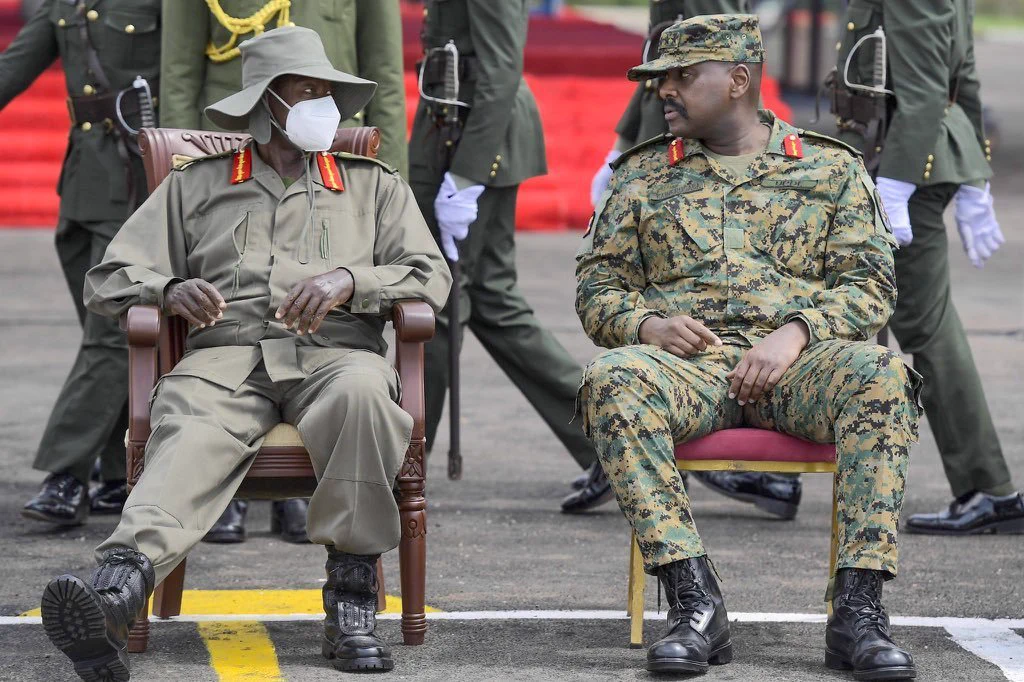
Uganda is facing renewed political uncertainty over the future of its leadership following reports that President Yoweri Museveni is considering his son, General Muhoozi Kainerugaba, as his preferred successor.
The controversy has reignited debate about whether Uganda is moving towards a political dynasty, with speculation surrounding a possible vice-presidential appointment, a 2032 transfer of power and claims of a prolonged period without national elections.
However, the developments must be examined against Uganda’s Constitution and the competing accounts emerging from within the ruling National Resistance Movement (NRM).
Museveni’s succession ambitions face questions within NRM
A report published by Kenya’s The Star on November 12, 2026, citing Agence France-Presse (AFP), revealed that senior NRM officials reportedly opposed efforts to position General Muhoozi Kainerugaba as Museveni’s successor.
According to five people who reportedly attended a closed-door NRM Central Executive Committee meeting on November 10, members raised objections to the proposal. A vote on Muhoozi’s candidacy was reportedly abandoned after disagreements emerged.
The report indicated that four members initially supported the proposal while three opposed it before the voting process was halted.
Some officials reportedly questioned Muhoozi’s political preparedness and suggested that he should leave active military service and gain experience in civilian politics before seeking the presidency.
However, the situation became more complicated on November 13 when NRM Secretary General Richard Todwong dismissed the report, describing claims that the party had rejected Muhoozi’s succession bid as false.
This conflicting information suggests that succession discussions are taking place amid considerable political sensitivity, although the precise position of the NRM leadership remains disputed.
Muhoozi has publicly indicated his intention to contest Uganda’s 2031 presidential election. Reuters reported in August 2026 that he had announced his presidential ambitions and expressed confidence in securing his father’s support.
Could Muhoozi become Uganda’s Vice President before 2032?
One scenario circulating among political commentators and government-connected figures is that Muhoozi could first become Vice President before eventually assuming the presidency.
However, there is currently no independently verified official announcement confirming such an appointment.
Uganda’s Constitution provides a specific procedure for appointing a Vice President.
Under Article 108, the President appoints the Vice President, subject to approval by a simple majority of Parliament. The appointee must also satisfy the constitutional qualifications required of a presidential candidate.
Importantly, becoming Vice President does not automatically make someone the elected President.
Article 109 provides that when a President dies, resigns or is removed from office, the Vice President assumes the presidency until a fresh election is held.
Such an election must ordinarily take place within six months.
Consequently, a possible Muhoozi vice-presidential appointment would not, by itself, establish a legitimate route to permanently inherit the presidency without an election.
Can Uganda legally suspend elections for ten years?
The suggestion that Uganda could go without elections for ten years under a proposed national rebuilding programme raises serious constitutional questions.
Article 105 establishes a five-year presidential term, while Article 77 provides for a five-year parliamentary term.
The Constitution also provides limited circumstances in which parliamentary terms can be extended during a war or state of emergency that prevents normal elections. Such extensions require parliamentary approval and cannot exceed six months at a time.
There is no general constitutional provision allowing a president to cancel national elections for ten years simply by announcing a rebuilding programme.
Article 109 also requires a presidential election within six months following a presidential vacancy, subject to the constitutional exception where the remaining presidential term is one year or less.
Therefore, the alleged ten-year election suspension should be treated as speculation, not an established government policy.
Any attempt to introduce such an arrangement would raise major constitutional and democratic accountability issues.
The military question: Can a serving General become President?
Muhoozi’s position as Chief of Defence Forces introduces another significant legal consideration.
Article 208(2) of Uganda’s Constitution requires the Uganda People’s Defence Forces (UPDF) to remain non-partisan and subordinate to civilian authority.
Furthermore, Section 16 of the Political Parties and Organisations Act restricts serving military personnel from participating in partisan political activities.
Section 97 of the UPDF Act also requires serving officers seeking political office to resign or retire from military service in accordance with the applicable regulations.
Ugandan courts have previously reinforced these restrictions.
This means that Muhoozi would face a significant legal requirement to leave active military service before pursuing elective political office.
The distinction is important: Uganda’s Constitution does not automatically disqualify former military officers from becoming presidents. The concern is participation in partisan politics while still serving in the armed forces.
Who could challenge Muhoozi in the next presidential election?
Although Uganda’s next presidential election is expected in 2031, potential opposition contenders are already identifiable from the country’s political landscape.
Robert Kyagulanyi, popularly known as Bobi Wine, remains the most prominent opposition figure. His National Unity Platform secured approximately 24.72 per cent of the presidential vote in January 2026, making him Museveni’s strongest challenger.
However, his political future faces serious uncertainty following the disputed election, his departure from Uganda and continuing tensions with the authorities.
Nathan Nandala Mafabi, the Forum for Democratic Change candidate, is another potential contender. He received approximately 1.88 per cent of the presidential vote in 2026.
Gregory Mugisha Muntu, leader of the Alliance for National Transformation, also remains relevant to discussions about opposition coordination and alternative leadership.
Other opposition politicians could emerge, particularly if the opposition parties agree to build a unified electoral platform.
Uganda’s political future: A succession battle with regional implications
The succession debate is bigger than whether Muhoozi eventually occupies State House.
It concerns the future of political institutions, military neutrality, democratic competition and the possibility of hereditary-style political succession in Uganda.
Museveni has governed Uganda since 1986. His continued influence over the ruling party, combined with his son’s military position and growing political profile, creates questions about how power will eventually change hands.
For the NRM, supporting Muhoozi could offer continuity but also risks alienating established party figures who believe succession should emerge through internal democratic structures.
For the opposition, the challenge will be converting public dissatisfaction into a credible, organised political alternative.
Ultimately, whether Muhoozi becomes Uganda’s next president will depend on political developments, constitutional compliance, party support and the outcome of the electoral process.
As of November 13, 2026, there is no confirmed agreement to install Muhoozi as Vice President, transfer power to him in 2032 or suspend Uganda’s elections for ten years. Nevertheless, the succession debate is real, politically significant and likely to remain one of the defining issues in Uganda’s politics ahead of 2031.