


A coalition of political parties, civil society organisations and other stakeholders has called for sweeping electoral reforms ahead of the 2027 General Election, demanding real-time livestreaming of election results, decentralised tallying and an independent audit of the voters’ register.
The People’s Coalition on Electoral Reforms says it has formally submitted a comprehensive legislative and regulatory reform package to the Independent Electoral and Boundaries Commission (IEBC), seeking changes to the country’s electoral framework before the August 2027 elections.
In a statement issued on Wednesday, November 25, 2026, the coalition argued that the proposed changes are necessary to strengthen transparency, accountability and public confidence in the electoral process.
At the centre of its proposals is the demand for electronic transmission and public livestreaming of results from polling stations, alongside the abolition of the National Tallying Centre in its current form.
The coalition has also proposed amendments to the Elections Act, 2011, through the Elections (Amendment) Bill, 2026, as well as changes to the Elections (General) Regulations, 2012 and Elections (Registration of Voters) Regulations, 2012.
Why the coalition wants election results livestreamed
It explained that electronic transmission involves the secure transfer of tabulated results, including Form 34A, from polling stations to constituency tallying centres.
Livestreaming, on the other hand, would allow the public, candidates, political parties, election observers and the media to access the transmitted results and voter turnout figures in real time through an IEBC-managed online portal.
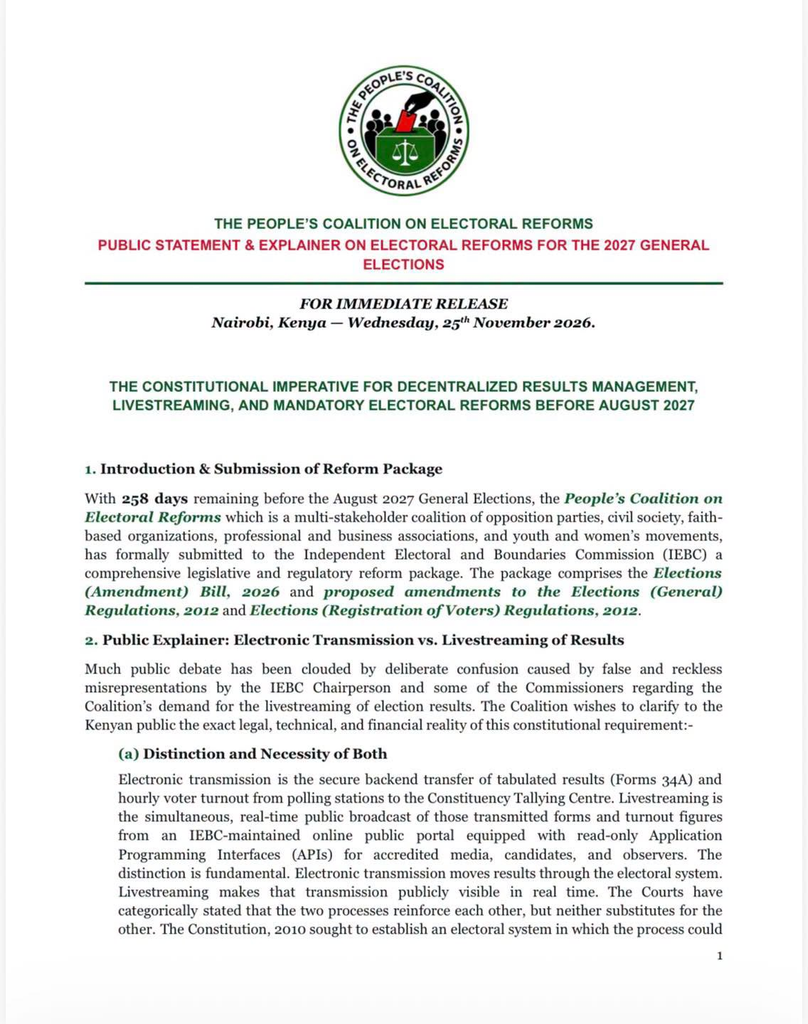
According to the coalition, making results publicly accessible as they are transmitted would allow independent scrutiny and verification of the electoral process.
It rejected claims that implementing livestreaming would require installing more than 55,000 cameras across polling stations, saying the proposal would instead integrate the IEBC’s Results Transmission System with an online portal.
Under the proposed arrangement, scanned results forms and hourly voter turnout figures would automatically become accessible to authorised stakeholders and the public through read-only application programming interfaces (APIs).
The coalition also dismissed concerns that the technology would cost billions of shillings, arguing that the proposed system would rely on existing digital infrastructure.
It maintained that electronic transmission and livestreaming should operate together rather than one replacing the other.
Push to abolish National Tallying Centre
Another major proposal is the abolition of the National Tallying Centre in its current form, with the coalition arguing that the centralised system creates unnecessary controversy and delays in the declaration of presidential election results.
Under the proposal, constituency and diaspora results would be publicly livestreamed before commissioners aggregate them and the IEBC chairperson formally declares the final presidential election outcome.
The coalition argues that counting, collating and tallying should remain the responsibility of presiding and returning officers, with the commission’s national leadership concentrating on the final constitutional declaration.

It cited Articles 86 and 138 of the Constitution, arguing that the proposed arrangement would strengthen transparency and reduce disputes surrounding the presidential results.
Nine electoral concerns ahead of 2027 polls
Beyond results management, the coalition has identified several issues it wants addressed before the next General Election.
Among its concerns is the integrity of the voters’ register, with the group demanding an independent audit and publication of the complete five-part register online in compliance with data protection laws.
It has also raised concerns over voter registration and the issuance of national identity cards, calling for equitable registration targets ahead of the enhanced voter registration exercise scheduled for January 2027.
On election technology, the coalition wants the IEBC to address the operational gap following the expiry of the Smartmatic framework contract on November 24, 2026.
It is proposing a shift away from dependence on a single technology provider towards decentralised, modular and independently audited electoral technology.
The coalition has further demanded transparent recruitment and public vetting of the IEBC Chief Executive Officer and Secretary, 47 County Election Managers and 290 Constituency Returning Officers.
It has also called for an end to what it describes as irregular staff transfers by current acting officials.
On ballot security, the proposals include competitive recruitment of returning officers, multi-party auditing of ballot-paper printing, strict serialisation and limiting additional ballot printing to 10 per cent.
Proposed changes to Elections Act
Through the Elections (Amendment) Bill, 2026, the coalition wants Section 39 of the Elections Act amended to make polling station results final while requiring hourly voter turnout figures and Forms 34A and 34B to be livestreamed.
The proposed amendments would also require the publication of transferred voters 90 days before elections and the release of an independent voters’ register audit report within 30 days.

The coalition is additionally proposing an integrated electronic diaspora register and secure remote e-voting, beginning with the 2027 presidential election.
The proposed system would use multi-factor and biometric authentication to separate voter identification from ballot choice.
It also wants amendments to the electoral regulations to eliminate the physical delivery of presidential results forms to a central national tallying centre.
Under the proposed changes, constituency returning officers would upload Form 34B directly to the public online portal, allowing commissioners to aggregate results from the 290 constituencies and diaspora publicly.
Coalition issues warning to IEBC and Parliament
The coalition has urged Parliament and the IEBC to immediately engage with its proposals, warning that failure to implement the proposed safeguards before August 2027 could trigger legal and other constitutional actions.
It says credible elections remain essential to Kenya’s democracy and that the public must be able to independently scrutinise the process rather than rely solely on official declarations.
“Should state institutions fail to implement these safeguards before August 2027, the People’s Coalition on Electoral Reforms will pursue every judicial, statutory, and direct sovereign avenue to defend the will of the Kenyan people,” the statement reads.
The coalition said its reform proposals are anchored in Articles 1, 2(5)-(6) and 3 of the Constitution, which it argues provide a basis for defending constitutionalism and electoral accountability.
It concluded with a call for urgent action, saying the proposed changes should be addressed before Kenyans head to the ballot in 2027.