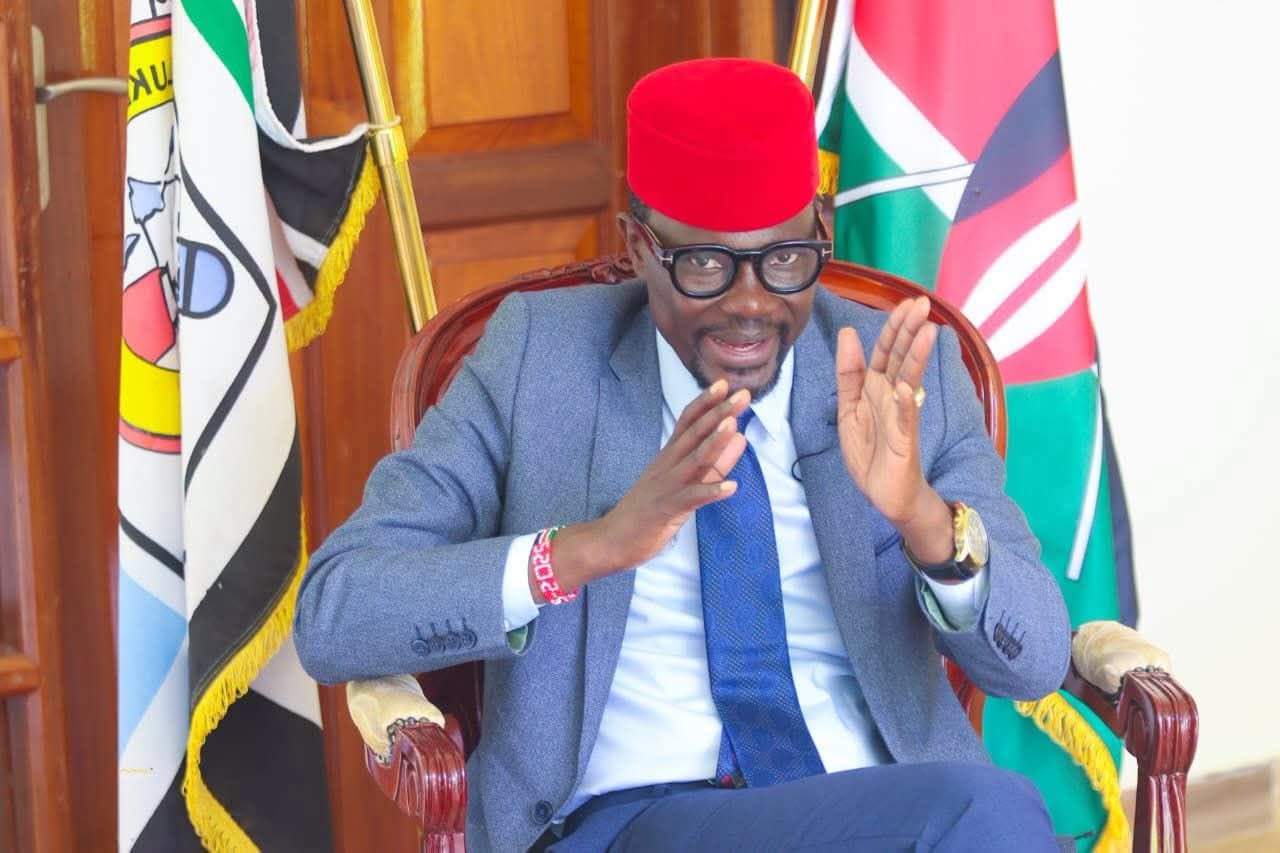
Jomo Kenyatta University of Agriculture and Technology (JKUAT) has disputed the authenticity of an engineering degree attributed to Kimilili MP Didmus Barasa, saying its records contain no evidence that he studied at the institution or graduated with a Bachelor’s degree in Electrical and Electronic Engineering.
The university’s position comes days after Barasa was awarded a PhD in Public Administration by Murang’a University of Technology, placing his academic history under renewed scrutiny. Murang’a University conferred the doctorate on August 28, 2026, after confirming that he had completed his doctoral requirements and defended his thesis.
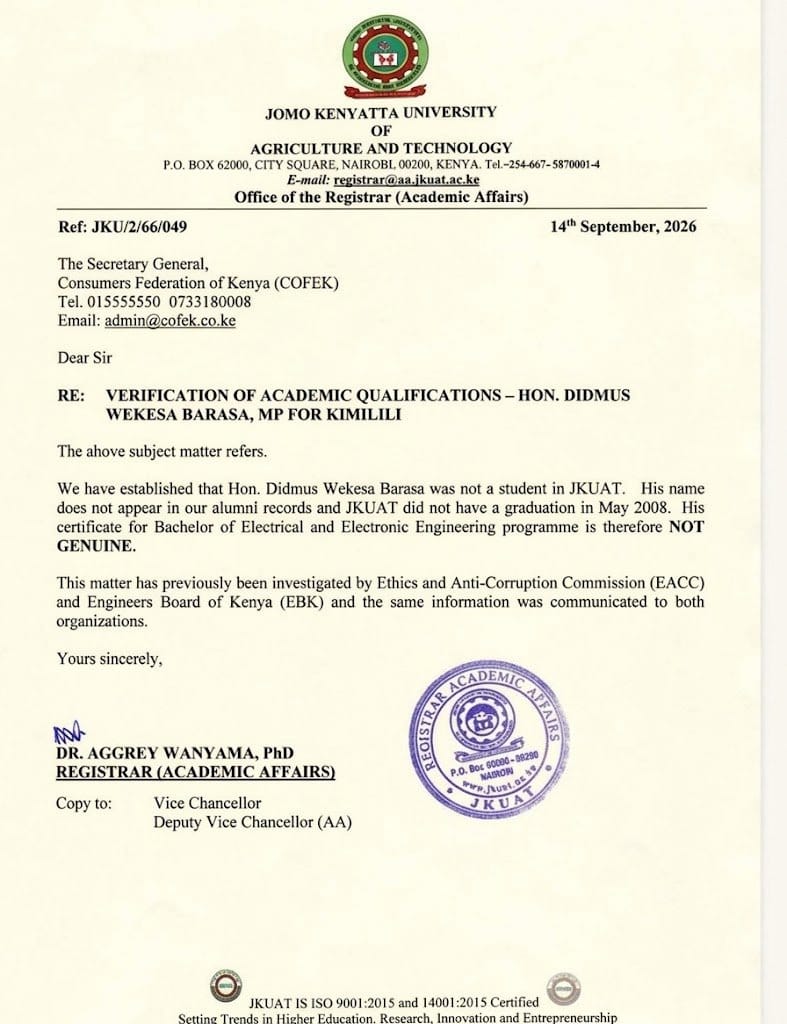
JKUAT’s latest response is contained in a letter dated September 14, 2026, addressed to the Consumers Federation of Kenya (COFEK) over questions concerning Barasa’s academic credentials.
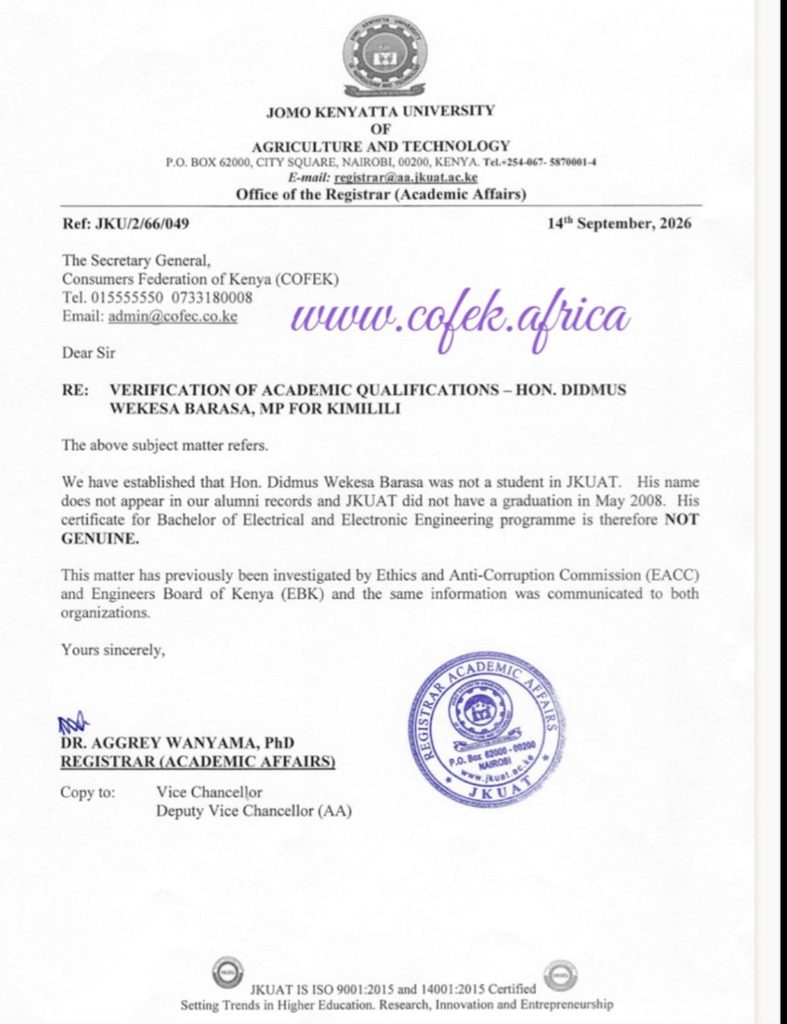
JKUAT Registrar Academic Affairs Dr Aggrey Wanyama said the university’s records did not list Barasa as a student or alumnus.
“His name doesn’t appear on our alumni records, and JKUAT did not have a graduation in May 2008. His certificate for Bachelor of Electrical and Electronic Engineering Programme is therefore “NOT GENUINE,” Dr Aggrey Wanyama, JKUAT Registrar Academic Affairs said.
The university also challenged the graduation details appearing on the certificate attributed to the MP, saying it did not hold a graduation ceremony in May 2008.
That finding contradicts information contained in Barasa’s parliamentary profile, which lists him as a 2005 JKUAT graduate in Electronic Engineering.
JKUAT further disclosed that concerns about the qualification had previously been brought to the attention of the Ethics and Anti-Corruption Commission (EACC) and the Engineers Board of Kenya (EBK).
“This matter has previously been investigated by the Ethics and Anti-Corruption Commission (EACC) and Engineers Board of Kenya (EBK), and the same information was communicated to both organisations,” the registrar said.
The university said it had communicated its findings to the two institutions for consideration and any action they deemed necessary.
The disclosure now raises questions over how Barasa’s disputed undergraduate qualification was previously handled by institutions responsible for investigating academic and professional credentials.
COFEK Secretary General Stephen Mutoro, who has previously questioned Barasa’s academic history, wants EACC, EBK and the Commission for University Education (CUE) to explain how they responded to information from JKUAT.
“EACC and EBK owe Kenyans a public accounting of what they did with JKUAT’s finding, and when the Council of University Education approve it,” Mutoro said.
The JKUAT development follows months of public scrutiny of Barasa’s academic journey, including questions raised around his admission to the doctoral programme at Murang’a University of Technology.
In June, COFEK called on CUE and the Directorate of Criminal Investigations (DCI) to investigate Barasa’s academic qualifications after Murang’a University confirmed that he had met the requirements for the award of a PhD in Public Administration.
Despite the earlier questions, Murang’a University proceeded to confer the doctorate on Barasa during its 10th graduation ceremony in August.
The latest JKUAT letter therefore introduces a separate and more specific dispute over an undergraduate engineering qualification attributed to the MP.
JKUAT’s finding is limited to the records and certificate in question. It does not, on its own, establish what action EACC, EBK or CUE may take, or determine the status of Barasa’s other academic qualifications.
The university has, however, put on record that Barasa does not appear in its alumni records, that it did not hold the graduation ceremony indicated on the disputed certificate, and that it considers the certificate “NOT GENUINE.”
The developments leave regulatory agencies facing renewed questions over how academic credentials presented by public officials are verified and how institutions respond when universities dispute the authenticity of qualifications.